10 Best Binocular Objects for the Southern Hemisphere
Explore the spectacular deep-sky treasures below the equator
Coordinates are J2000.0 equatorial coordinates.
The southern sky holds some of the most spectacular deep‑sky treasures visible to the naked eye and binoculars. With a simple pair of 7×50 or 10×50 binoculars, you can explore globular clusters that rival the full Moon, entire neighbouring galaxies, and star clusters bursting with colour. This list covers the very best targets for binocular observers below the equator — from the legendary Omega Centauri to the shimmering Southern Pleiades.
🌏 Southern Hemisphere Advantage: Unlike the northern sky, the south has easy access to the Milky Way's bright central bulge, two dwarf galaxies (the Magellanic Clouds), and some of the biggest globular clusters known — all visible with just a pair of binoculars!
1) Omega Centauri (NGC 5139)
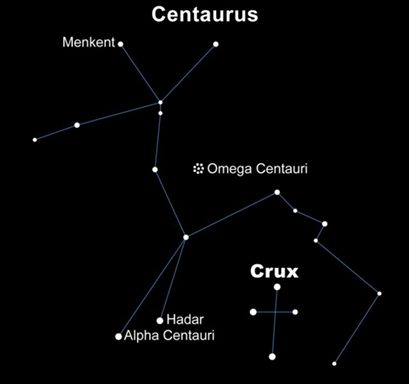
This most spectacular globular cluster appears as a large bright prominent fuzzy ball of light, approximately the same size as the full moon with a 7×50 binoculars. The intensely bright central core fades into a broad misty halo. The colour is a soft warm white with a hint of gold, especially under dark rural skies. It dominates the field, filling a large portion of the view even with the wide 7×50 field. Individual stars are not resolved but there is a graininess or granular texture that hints at the millions of stars packed within. Unlike many other globular clusters that appear perfectly round, Omega Centauri has a noticeably oval, or oblate shape.
2) The Large Magellanic Cloud (LMC)
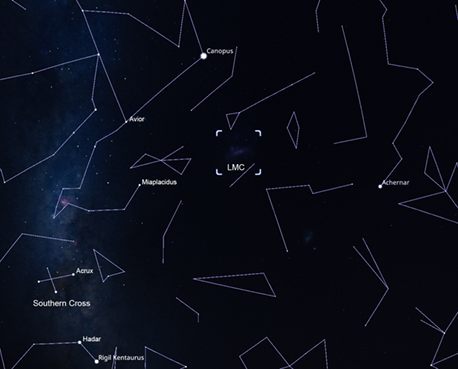
The LMC appears as a large, irregular, pale‑silver cloud (not the vivid pinks and blues seen in astrophotography). It is far bigger than any nebula or cluster you've seen. It spans several degrees, so wide that it fills a substantial portion of your binocular field. The edges are soft and uneven, fading gradually into the background sky. Its elongated core anchors the softer, irregular glow of the surrounding galactic disk and gives the galaxy a distinct sense of shape. The LMC looks distinctly grainy. This uneven, patchy texture is caused by the sheer concentration of open star clusters, globular clusters, and smaller nebulae embedded throughout the galaxy.
3) 47 Tucanae (NGC 104)
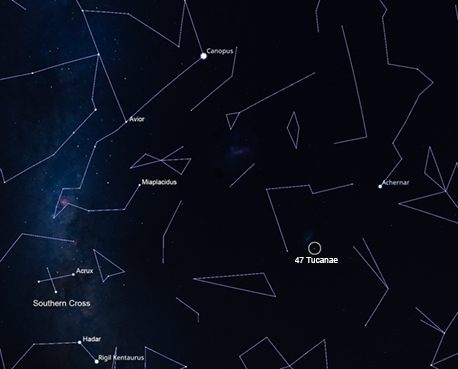
It is the second brightest globular cluster after Omega Centauri, visible to the naked eye as a slightly fuzzy star, but a pair of 7×50 binoculars completely transforms its appearance. It appears as a large, perfectly round ball of soft, pearly light with a graininess around the outer edges — almost like a tiny, luminous pearl suspended in the sky. While individual stars are not resolved, its nature as a distinct, non-stellar object is unmistakable. The cluster spans about 31 arcminutes, which is roughly the same apparent diameter as the full Moon.
4) Eta Carinae Nebula (NGC 3372)
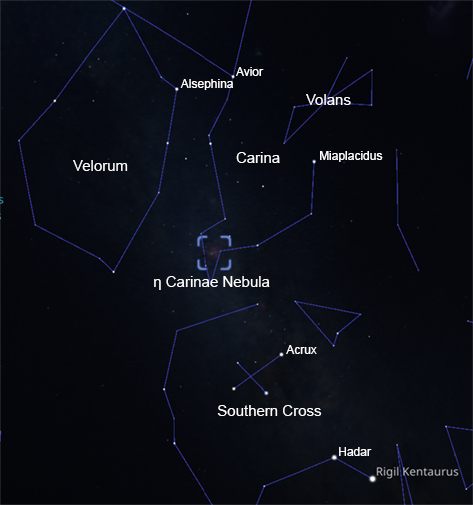
It is one of the most spectacular sights in the southern night sky, arguably outperforming the famous Orion Nebula in sheer scale. The 2° wide nebula fits perfectly, framed by an incredibly rich backdrop of the Milky Way. It appears as a massive, frosty patch of light roughly three times the width of the full Moon. It won't show the vivid pinks and reds seen in astrophotography, so you will perceive the nebulosity as a ghostly, pale grey or silvery luminescence. Distinct, knotty lobes can be observed. The most obvious structural feature is a dark, prominent rift of obscuring dust that cuts right through the brightest central region, violently dividing the glowing clouds of gas. Near the centre of this celestial spectacle, you'll see the bright star Eta Carinae itself.
5) The Tarantula Nebula (NGC 2070)
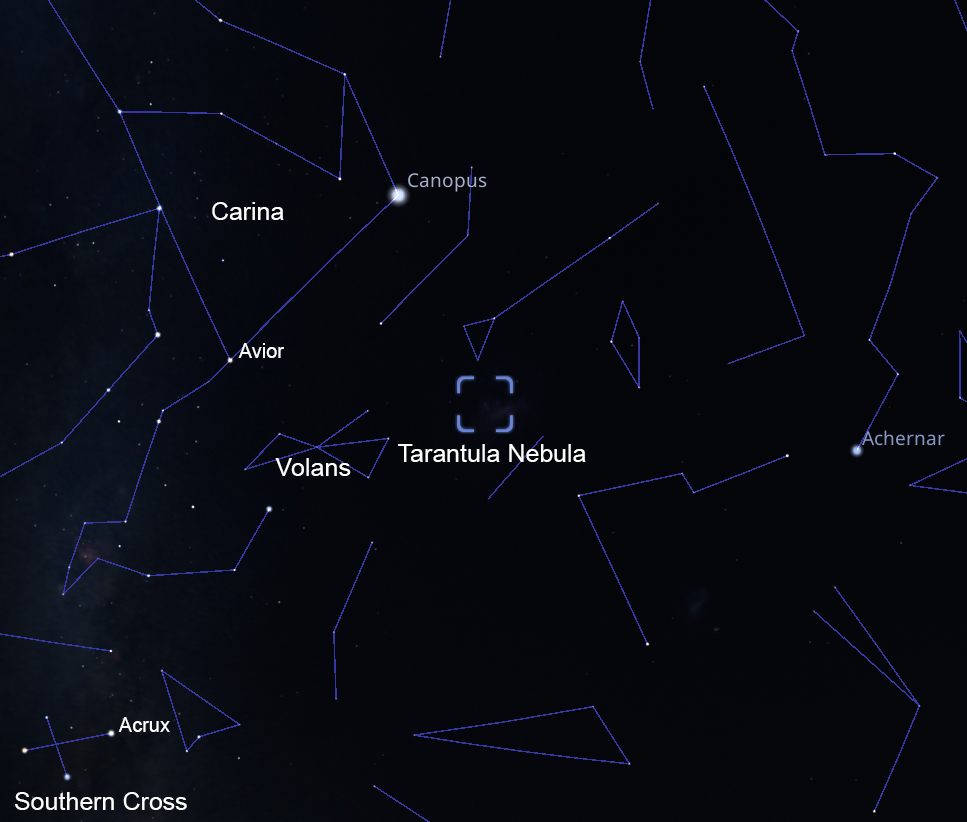
It appears as a prominent, intensely bright, and somewhat distinct, glowing "milky" smudge within the Large Magellanic Cloud (LMC). It does not explicitly show delicate "spider legs" like long-exposure photographs do. The nebula has an irregular, slightly elongated shape with a bright, condensed centre. This core is R136, a massive cluster of supergiant stars powering the nebula's glow. Sitting on the outskirts of the LMC, it appears beautifully framed against a rich, grainy backdrop of thousands of faint, unresolved companion stars.
6) The Jewel Box Cluster (NGC 4755)
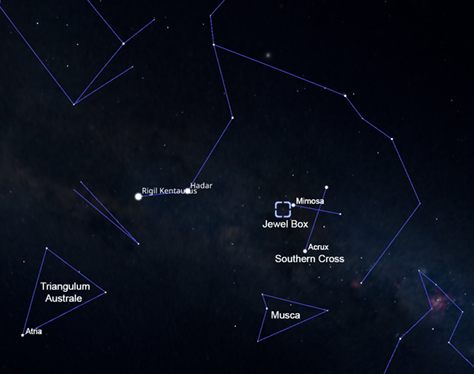
The Jewel Box appears as a small, bright, concentrated patch of stars, sitting right next to the Coal Sack Nebula, one of the darkest regions of the Milky Way. Framed by an inky tapestry, the cluster's stars pop with breathtaking clarity. The brightest members form a distinct asterism often described as shaped like an uppercase "A". The Jewel Box earned its name because of its striking colour contrast. Most of its stars are blazing, icy blue-white supergiants. However, sitting right near the centre of the "A" is a prominent red supergiant (Kappa Crucis). It looks like a single orange-red gem nestled tightly inside a pocket of icy blue diamonds, perfectly mirroring a velvet-lined box of precious stones.
7) Centaurus A (NGC 5128)
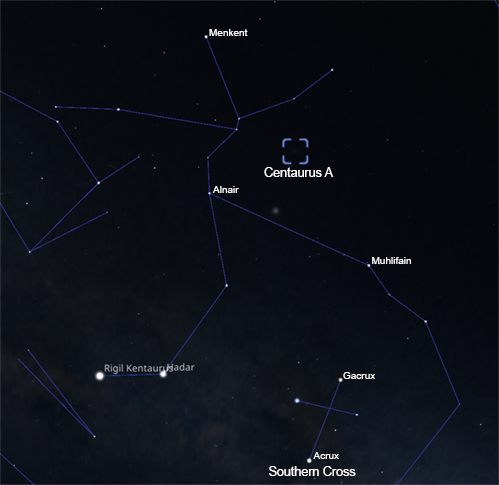
Centaurus A appears as a soft, distinct, ghostly smudge of grey light, slightly elongated rather than round. Because its light is spread out over a relatively large area (about 25×20 arcminutes, roughly two thirds the size of the full Moon), this gives it a low "surface brightness," making it appear much fainter than its magnitude of 7 suggests. Astrophotos show a prominent dark lane of dust that cuts across its bright centre. However, detecting Centaurus A's obscuring dust lane is the supreme challenge for a 7×50 binocular. It demands excellent optics, pristine dark skies, perfect dark adaptation and outstanding atmospheric transparency. Realistically, a pair of 15×70 or 20×80 may be required. The galaxy sits in a rich region of Centaurus, so the field around it is sprinkled with faint stars, enhancing the impression that the galaxy is a foreign object.
8) The Small Magellanic Cloud (SMC)
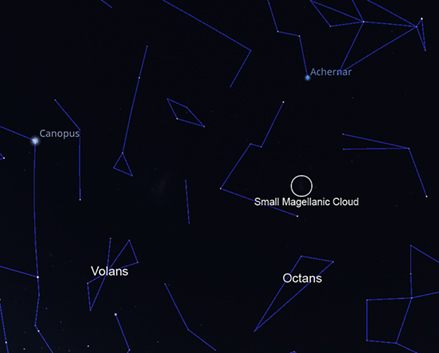
Spanning 4° by 3°, the entire galaxy will fit comfortably within the 7×50 binocular field of view. It appears as a bright, hazy glow with a mottled look giving it a granular uneven appearance. The lopsided oval shape has a feathered, nebulous edge that melts into the background sky. Individual stars are not resolved. The brightest region is its central "bar" or core, which runs roughly north-to-south. This area appears noticeably denser and brighter than the fraying, nebulous edges of the galaxy. As an added bonus within the same field of view are two globular clusters — 47 Tucanae (NGC 104) and NGC 362.
9) The Southern Pleiades (IC 2602)
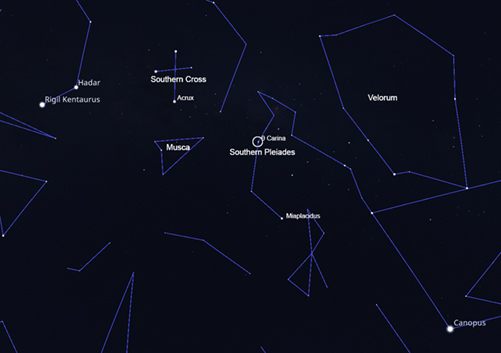
Also known as Theta Carinae Cluster, it is a truly stunning sight and one of the finest open clusters in the southern sky. Spanning nearly a full degree, the cluster fits perfectly within a 7×50 binocular's typically wide field of view. The undisputed centrepiece of the view is Theta Carinae (θ Car), a striking blue-white star shining at magnitude 2.7. It sits right near the centre of the cluster. Surrounding Theta Carinae, you will see dozens of fainter stars scattered across the view. The cluster contains about 60 member stars in total, with most of the other main members being of 5th and 6th magnitude. About 15 to 25 distinct bright stars can be easily resolved. Because IC 2602 is embedded in a rich region of the Milky Way, the background of your field of view won't be empty black space. It will be dusted with a faint, carpet-like glow of hundreds of unresolved, distant stars.
10) The Southern Beehive Cluster (NGC 2516)
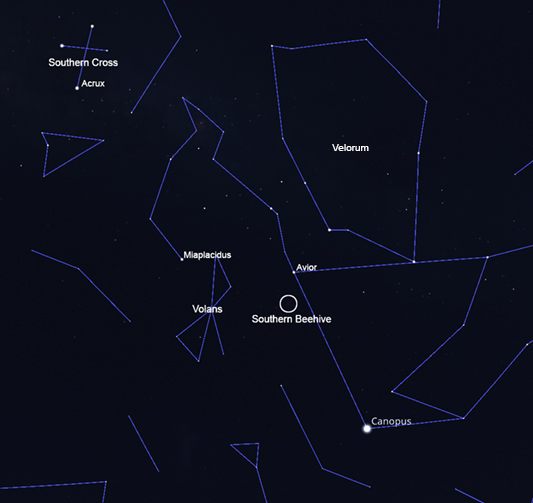
Under a dark sky, a pair of 7×50 binoculars transforms this naked-eye fuzzy patch into a stunning celestial view. It spans an area roughly the size of the full Moon, but its stars are packed tightly together. At first it looks like a bright fuzzy patch of light but as your eyes adapt, a glittering swarm of 30–60 individual stars can be seen. The vast majority of the stars shine with a hot, crisp blue-white light. With dark adaptation, dark skies, good transparency and a steady hand, it is possible to discern the colours of two orange-red stars near the outer edge of the cluster.
🔭 Final Tip: For the best experience, use a tripod or lean against a solid support to steady your binoculars. Dark, moonless nights and good dark adaptation will make all the difference. Happy hunting under the southern stars!