Binocular Objects for the Northern Hemisphere
Explore ten celestial treasures — from Andromeda to the Coma Star Cluster
Coordinates are J2000.0 equatorial coordinates.
These ten objects represent only a small sample of what binocular astronomy has to offer. A modest pair of 7×50 binoculars can reveal hundreds of star clusters, nebulae, galaxies and double stars invisible to the unaided eye. Their wide field of view provides a perspective that even large telescopes cannot match, making binoculars one of the finest instruments for exploring the beauty and scale of the night sky.
1) Andromeda Galaxy (M31 NGC 224)
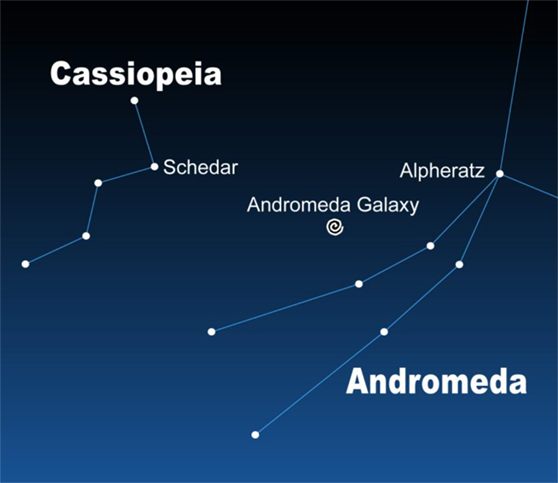
The Andromeda Galaxy is the most distant object routinely visible to the unaided eye, located approximately 2.5 million light-years away. Under clear, dark skies it is best seen using averted vision—looking slightly to one side rather than directly at it, allowing the eye's more sensitive peripheral vision to detect its faint glow.
Through a pair of 7×50 binoculars, the galaxy appears as a diffuse, elongated spindle of soft, fuzzy light stretching nearly 3° from end to end, with a brighter, star-like core. Its two companion galaxies, M32 and M110, can also be detected. M32 is relatively easy to see, while the larger and more diffuse M110 usually requires averted vision and darker skies.
2) The Pleiades (M45)
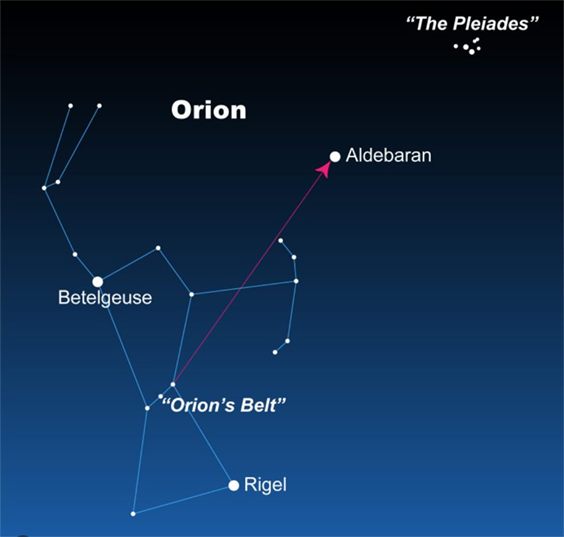
Also known as the Seven Sisters, the Pleiades is one of the finest open clusters in the sky and a spectacular binocular target. The cluster spans roughly 2° across, fitting comfortably within the field of view of a 7×50 binocular.
What appears to the naked eye as a small hazy patch transforms into a glittering swarm of 20 to 50 diamond-like, blue-white stars scattered against a dark sky. Look carefully for subtle golden-orange stars among the predominantly blue-white members, providing a beautiful contrast of colour.
3) The Orion Nebula (M42 NGC 1976)
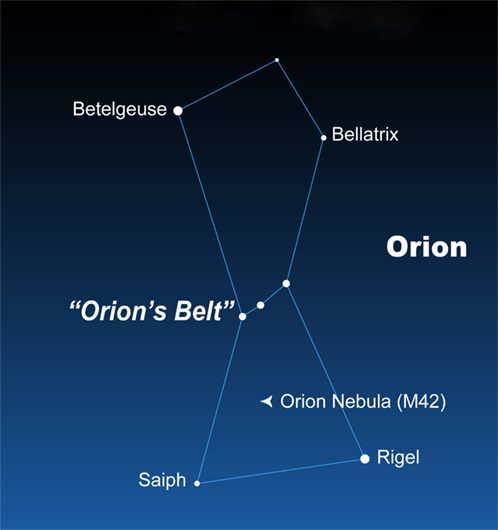
The Orion Nebula is one of the most spectacular sights in the winter sky. Through 7×50 binoculars it appears as a distinct, softly glowing cloud, brighter towards the centre and fading gradually into the surrounding darkness.
Do not expect the vivid pinks, reds and purples seen in long-exposure astrophotography. Instead, the nebula appears as a silvery-grey cloud with a faint greenish tint and an irregular, misty shape. At 7× magnification, the four stars of the Trapezium at its heart usually merge into a single bright point, surrounded by a beautiful scattering of stars that appear embedded within the glowing nebula.
4) The Double Cluster (NGC 869 & NGC 884)
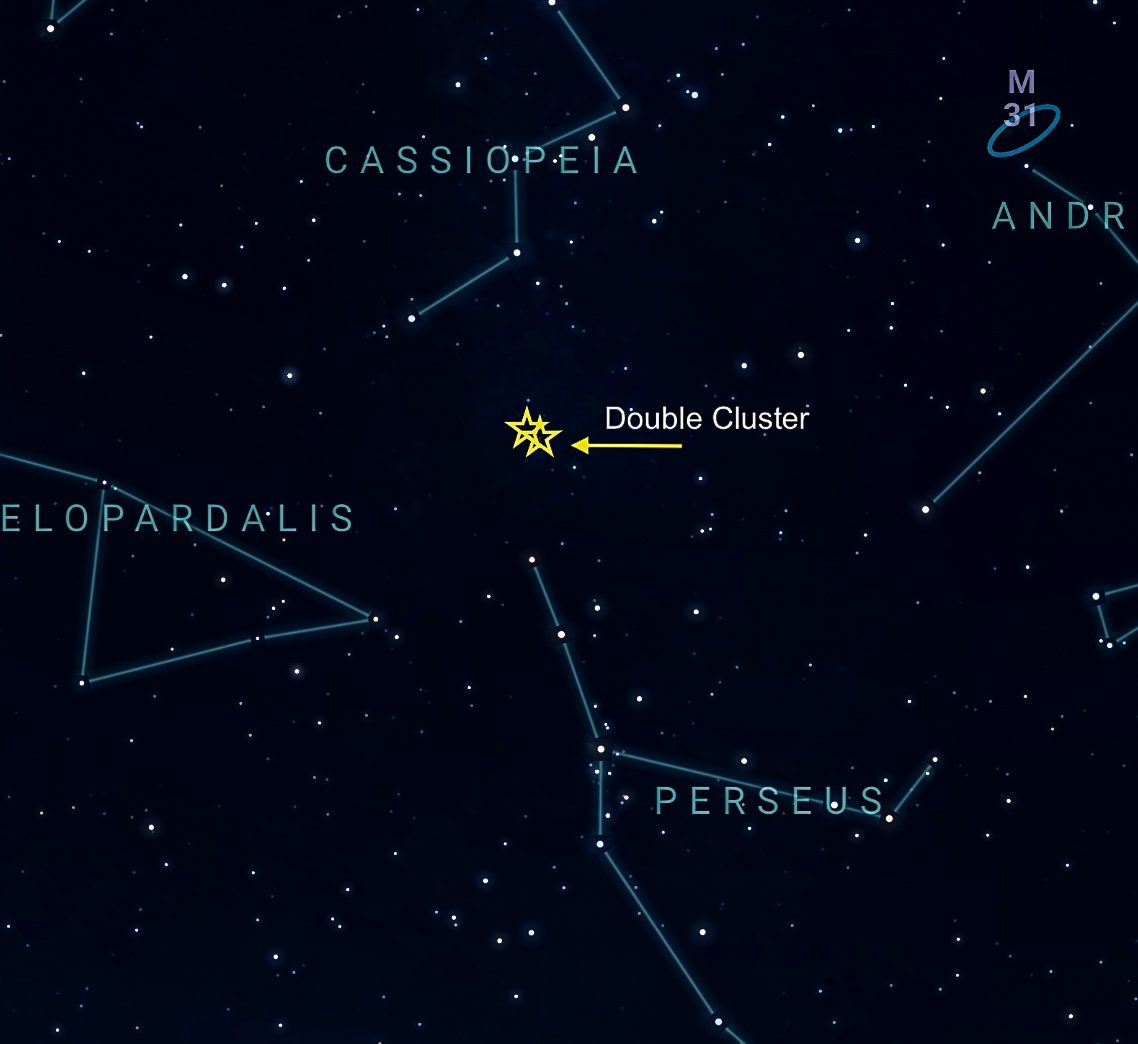
The Double Cluster is arguably one of the most spectacular binocular sights in the northern sky. These two young open clusters fit beautifully together in the same field of view of a 7×50 binocular.
NGC 869 appears slightly brighter, richer and more densely packed towards its centre, while NGC 884 appears a little larger and more loosely scattered. Under dark skies, dozens of individual stars can be resolved, surrounded by the rich background star fields of the Milky Way.
5) The Hercules Cluster (M13 NGC 6205)
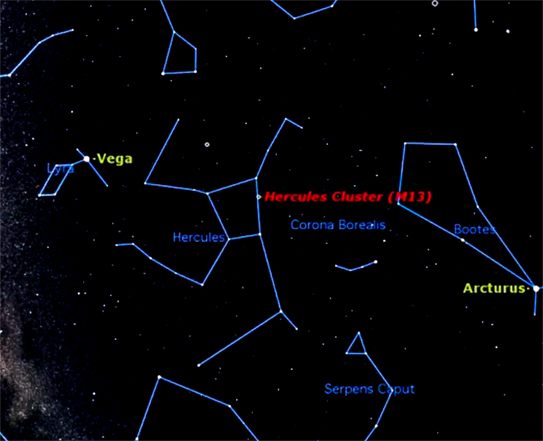
M13 is one of the finest globular clusters visible from the northern hemisphere. Through 7×50 binoculars it appears as a small, round glow surrounded by a vast ocean of background stars.
It is brightest and most concentrated at the centre, with the light gradually fading towards the edges, giving it the appearance of a perfectly round, pale grey-white misty patch. Individual stars remain unresolved, but its compact and concentrated appearance clearly distinguishes it from ordinary star fields.
6) Albireo (Beta Cygni)
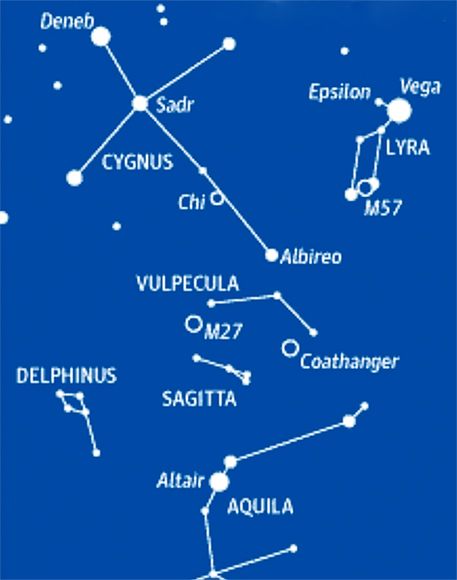
Albireo is one of the most beautiful double stars in the night sky. The brighter primary star, Albireo A, shines with a rich golden-yellow or orange colour at magnitude +3.1, while its companion, Albireo B, is a striking sapphire-blue star of magnitude +5.1.
This dramatic colour contrast makes Albireo a favourite among observers. Under exceptionally steady conditions, a carefully mounted 7×50 binocular may just separate the pair, although most observers will find it difficult. A mounted pair of 15×70 binoculars provides a much more satisfying view.
7) The Coathanger (Collinder 399)
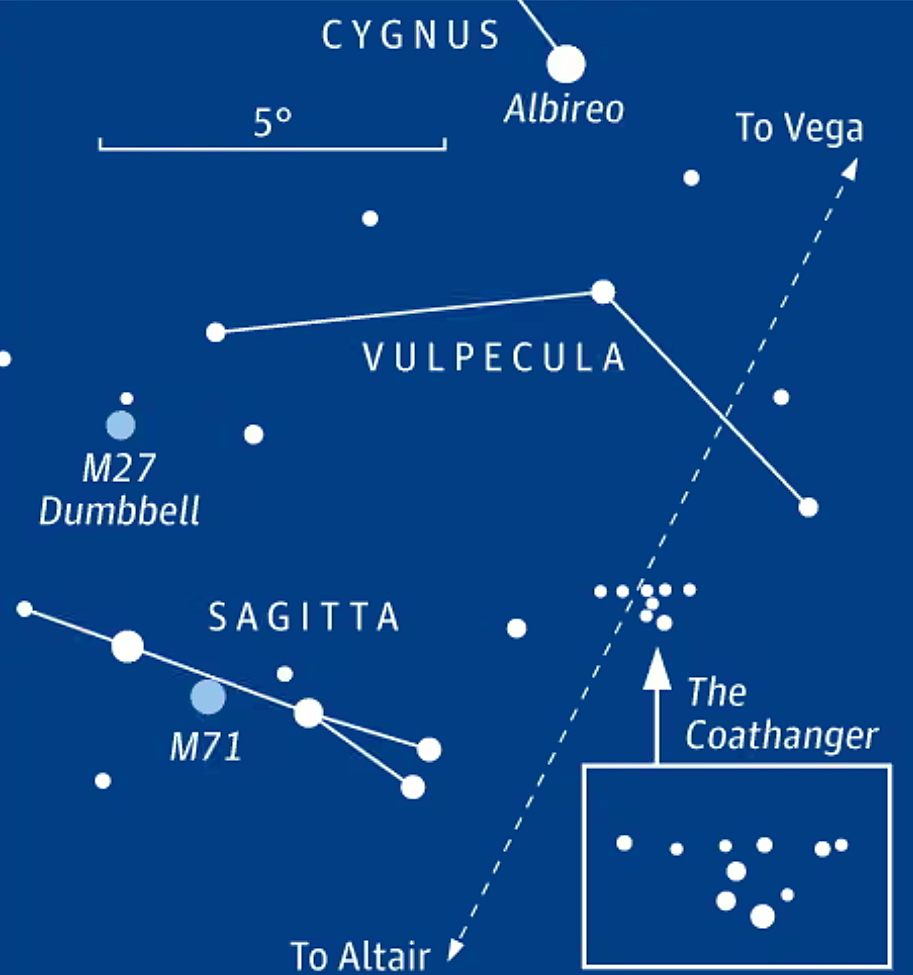
The Coathanger is a delightful asterism—a chance alignment of stars rather than a true cluster. It immediately resembles an upside-down coathanger, with six stars forming a straight line and four stars creating the curved hook.
The group contains about ten stars ranging from 5th to 7th magnitude and spans roughly 1½° across. This makes it perfectly suited to a wide-field 7×50 binocular, where its distinctive shape is immediately recognisable.
8) The Beehive Cluster (M44 NGC 2632 / Praesepe)
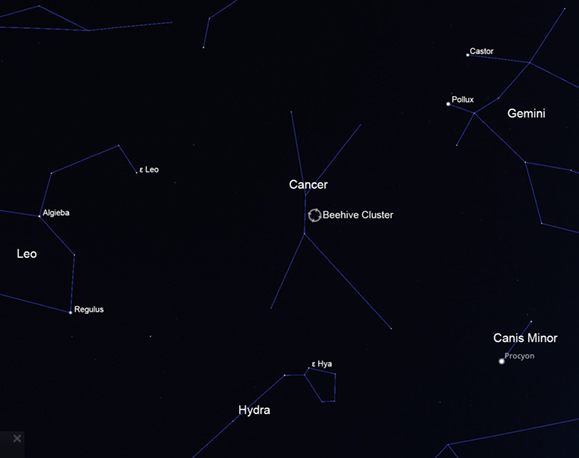
The Beehive Cluster is one of the finest binocular objects in the sky and is beautifully framed in a 7×50 binocular. What appears to the naked eye as a faint hazy patch becomes a rich, sparkling swarm of stars spread across an area about three times the apparent diameter of the full Moon.
Around 30 to 60 stars can be individually resolved, while many fainter members remain unresolved, creating a delicate grainy texture. The overall impression is that of a celestial beehive filled with countless tiny points of light.
9) The Hyades Star Cluster (C41)
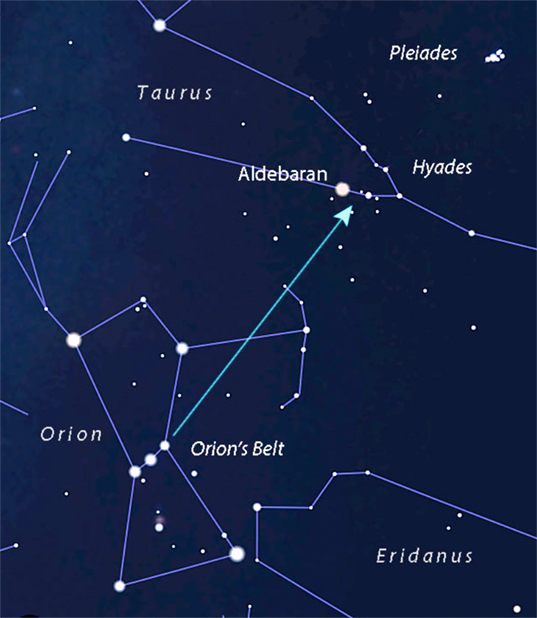
The Hyades is the closest open cluster to Earth and spans an impressive 5.5° across the sky. Since most 7×50 binoculars have a field of view of about 6° to 7°, the entire cluster nearly fills the view.
The famous V-shaped pattern of stars is immediately obvious. One tip of the V is marked by Aldebaran, a brilliant orange-red star. Although Aldebaran appears to be part of the cluster, it is actually a much closer foreground star and is not a true member.
Because of its proximity to Earth, the stars of the Hyades are widely separated, allowing 30 to 40 stars to be easily resolved across the field.
10) Melotte 111 (Coma Star Cluster)
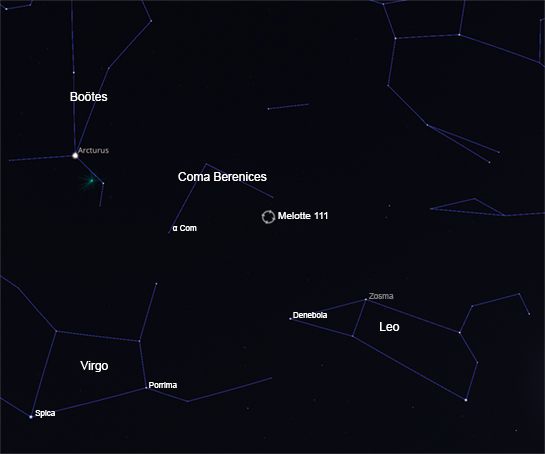
Melotte 111 is one of the finest large binocular star clusters in the spring sky. Through a 7×50 binocular it appears as a vast, loose collection of around 40 to 50 bright stars scattered across a wide area of sky.
Unlike compact clusters such as the Pleiades, Melotte 111 is open and irregular, with its brighter stars forming graceful chains and gentle curves. Its large size makes it perfectly suited to binoculars, and the entire cluster fits comfortably within their wide field of view.
These ten objects represent only a small sample of what binocular astronomy has to offer. A modest pair of 7×50 binoculars can reveal hundreds of star clusters, nebulae, galaxies and double stars invisible to the unaided eye. Their wide field of view provides a perspective that even large telescopes cannot match, making binoculars one of the finest instruments for exploring the beauty and scale of the night sky.