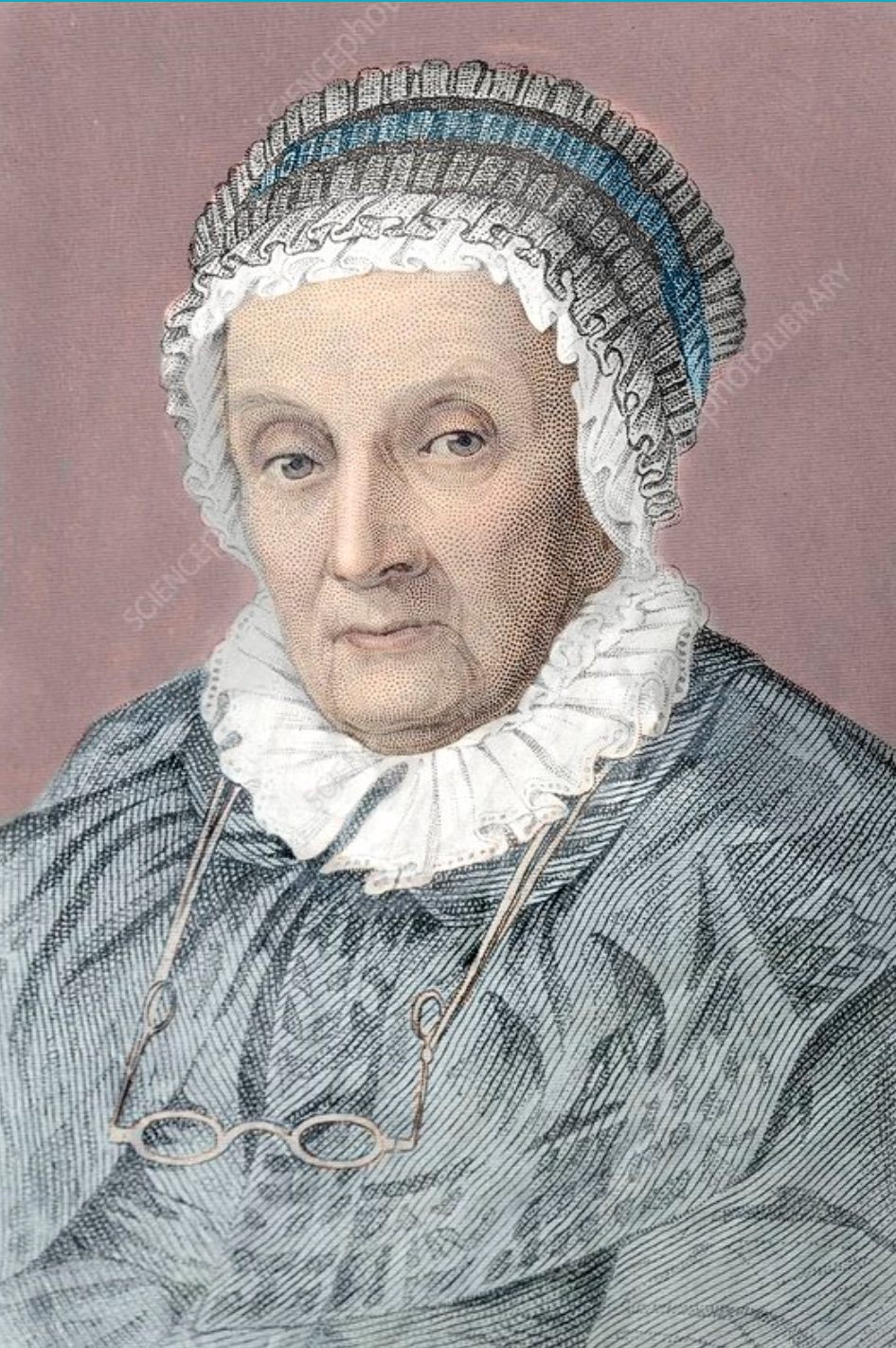
Caroline Herschel
 ...
...
The Unsung Herschel: Caroline Herschel
Caroline Herschel was born in Hanover on 16 March 1750, the eighth child and fourth daughter of Isaac Herschel. History often celebrates great discoverers while overlooking those whose quiet dedication made those achievements possible. Behind many remarkable figures stands a devoted supporter whose patience, loyalty, and tireless work sustain the mission. Caroline Herschel was long regarded as one of these hidden helpers — the devoted sister who faithfully assisted her brother, William Herschel, in his astronomical pursuits. Yet this view greatly understates her own extraordinary accomplishments.
Although Caroline worked closely with William in observing the night sky, she became a distinguished astronomer in her own right. Her contributions transformed observational astronomy, particularly in the study of comets and the organisation of stellar catalogues. Between 1786 and 1797 she discovered eight comets, becoming the first woman credited with the discovery of a comet. Her discoveries earned her international recognition and established her as one of the leading observational astronomers of her era.
Caroline played a vital role in William Herschel's ambitious surveys of the heavens. Night after night she assisted him by sweeping the skies for nebulae and star clusters, carefully recording observations, performing calculations, and organising enormous quantities of astronomical data. Without her diligence and precision, many of William's discoveries would have been far more difficult to achieve.
Her own independent work was equally significant. Caroline corrected numerous errors in the star catalogues of John Flamsteed, Britain's first Astronomer Royal, greatly improving the accuracy of astronomical records. She also discovered several deep-sky objects, including galaxies and open star clusters. Among her most famous discoveries was Messier 110, a companion galaxy to the Andromeda Galaxy.
A Paid Scientist — In the 18th Century
When William was appointed Astronomer Royal to King George III in 1782, Caroline received an annual salary of £50 (roughly £6,000 today) for assisting him. This made her arguably the first woman in Britain to be paid professionally as a scientist, giving her an unusual degree of financial independence for a woman of the eighteenth century.
Recognition Delayed but Deserved
Following William's discovery of Uranus in 1781, he was elected to the Royal Society. Recognition for Caroline came more slowly. In 1828 she was awarded the Gold Medal of the Royal Astronomical Society for her astronomical work — an honour no other woman would receive until Vera Rubin in 1996. In 1835 Caroline was granted honorary membership of the Society, at a time when women were still barred from full membership. Women would not gain full membership rights in the Royal Astronomical Society until 1916.
Interesting Facts About Caroline Herschel
📏 Tiny Stature, Giant Legacy: At the age of ten, Caroline contracted typhus, a severe illness that permanently stunted her growth. She remained only about 130 cm (4 ft 3 in) tall and also lost the sight in her right eye. Her mother believed she would never marry and intended her for domestic service.
🎵 From Housekeeper to Soprano: William Herschel brought Caroline from Germany to England, initially to serve as his housekeeper. However, she soon developed her own talents and became an accomplished soprano soloist, performing in major musical productions in Bath.
⏳ A Remarkable Lifespan: She lived to the remarkable age of 97. Even after William's death, Caroline continued working on astronomical catalogues and organising observational records after returning to Hanover.
🏆 Pioneer of Recognition: In later life she received numerous honours for her achievements, becoming one of the first women in history to gain widespread recognition in professional astronomy.
Far from being merely the assistant of a famous brother, Caroline Herschel emerged as one of the pioneering women of science. Her perseverance, skill, and dedication helped reshape astronomy and opened doors for future generations of women astronomers.
Caroline Herschel's story reminds us that behind many great discoveries stand remarkable individuals whose contributions history has too often overlooked. She was not merely William's assistant — she was a pioneering scientist, a comet hunter, a catalogue corrector, and an inspiration.