SN 1987A: The star that broke the rules
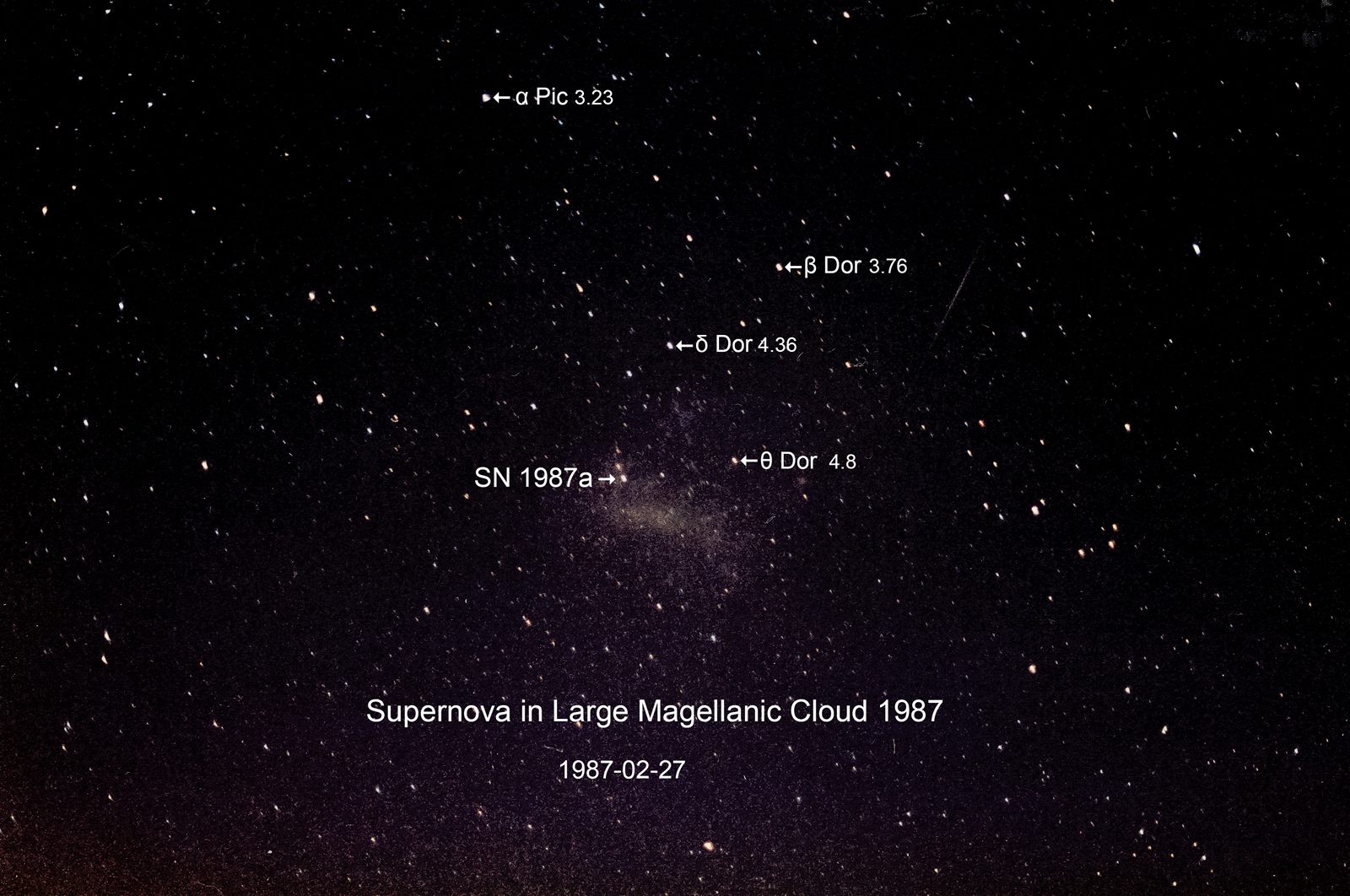
On the night of 23–24 February 1987, astronomer Ian Shelton was photographing the Large Magellanic Cloud from Las Campanas Observatory in Chile when he noticed a bright star on his photographic plate that had not been there before. He stepped outside, looked towards the Large Magellanic Cloud, and saw the newcomer with his own eyes. Almost simultaneously, Las Campanas telescope operator Oscar Duhalde independently spotted it in the sky. New Zealand amateur astronomer Albert Jones also found it independently that night, and Australian astronomer Robert McNaught, who had unknowingly photographed it the evening before, helped confirm the discovery.
The object was designated Supernova 1987A. It was a core-collapse supernova, specifically classified as an unusual Type II event, produced by the death of a massive star. For millions of years, such a star maintains a precarious balance between gravity and the pressure generated by nuclear fusion. As successive stages of fusion build heavier elements in its core, the star eventually forms an iron-rich core. Iron cannot yield energy through further fusion, so the source of pressure supporting the core collapses. In less than a second, the core implodes to extraordinary density, producing a flood of neutrinos and triggering the violent explosion of the star's outer layers.
SN 1987A was the closest supernova observed since Kepler's Supernova of 1604, which exploded in our own Galaxy, and the first visible to the naked eye since then. It quickly became one of the most intensively observed astronomical events ever recorded.
The explosion occurred about 168,000 light-years away in the Large Magellanic Cloud, a small satellite galaxy of the Milky Way. The explosion itself therefore happened roughly 168,000 years before human beings saw it. Supernovae are not particularly rare, but most occur in much more distant galaxies, millions or billions of light-years away, where even a colossal stellar explosion appears as little more than a point of light.
Messengers from the core
One of the most remarkable discoveries came not from light, but from neutrinos. Several underground particle detectors recorded a burst of neutrinos two to three hours before the visible light of the supernova reached Earth. Kamiokande II in Japan detected 12 candidate neutrino events over about 13 seconds, while the IMB detector in the United States recorded 8 and the Baksan detector in the Soviet Union recorded 5. The neutrinos had not travelled faster than light. They escaped directly from the collapsing core, whereas the visible light was initially trapped inside the star. The shock wave had to travel outward through the star before the explosion could become visible at its surface.
The star that exploded
SN 1987A also provided astronomers with something extraordinary: a before-and-after photograph of the exploding star. Because the Large Magellanic Cloud had been photographed repeatedly before 1987, astronomers could search archival images for the star that had occupied the precise position of the supernova. They identified Sanduleak −69° 202, a hot B3 blue supergiant that had been catalogued at about 12th magnitude. It was estimated to have had roughly 20 times the mass of the Sun.
This was a major surprise. At the time, astronomers generally expected Type II supernovae to arise from red supergiants—massive stars that had expanded enormously and developed cool outer atmospheres. Sanduleak −69° 202 was instead a hot, compact blue supergiant.
The explanation appears to lie in the star's unusual evolutionary history. The progenitor probably passed through a red-supergiant phase, losing substantial amounts of material, before contracting and heating again to become a blue supergiant shortly before its core collapsed. Binary interaction or a merger may also have played a role. Its blue-supergiant state helps explain why SN 1987A behaved differently from many expected Type II supernovae: its light initially rose relatively slowly and reached only about magnitude 3 at maximum, nearly three months after the explosion.
As the supernova faded, another important clue emerged. Much of its continuing luminosity was powered by radioactive decay. The explosion produced radioactive nickel-56, which decayed into cobalt-56, which in turn decayed into stable iron-56. The energy released by these radioactive transformations heated the expanding debris and kept it glowing. The observed decline in brightness closely followed the expected radioactive decay, providing a striking confirmation of the physics taking place inside the expanding remnant.
The rings
Then came one of SN 1987A's most spectacular features: its rings.
Images from the Hubble Space Telescope revealed a bright equatorial ring about a light-year across, accompanied by two much fainter outer rings. These structures were not created by the explosion itself. Instead, they consist of material expelled by the progenitor star thousands of years before the supernova, probably during its earlier red-supergiant phase, or as a result of a merger with a companion star. The geometry of the rings reflects the complicated winds and mass loss that occurred as the star evolved.
Initially, the ultraviolet flash from the supernova illuminated the ring, making it glow. But in the years that followed, the expanding blast wave caught up with the dense ring material. By the early 2000s, shocks were producing dozens of brilliant hotspots around the ring, creating a spectacular appearance reminiscent of a string of pearls. The collision generated intense X-rays and heated the surrounding gas to enormous temperatures.
What was left behind?
For decades, however, one of the biggest questions remained unanswered: what was left at the heart of the explosion?
A core-collapse supernova should leave behind either a neutron star or, if the collapsing core is sufficiently massive, a black hole. Despite extensive searches, astronomers could not directly detect a pulsar, neutron star or black hole at the centre of SN 1987A. Importantly, the neutrino observations confirmed that a core-collapse event had occurred, but they did not by themselves prove that the remnant was a neutron star.
Then, in 2024, the James Webb Space Telescope provided the strongest evidence yet. Webb detected emission from highly ionised argon and sulphur in the dusty central region of the remnant. Producing these ions requires an energetic source of radiation, and the most plausible explanation is radiation from a newly formed neutron star buried within the expanding debris. The observations therefore strongly favour a neutron star, although they do not constitute a direct detection of the compact object itself.
Webb has also revealed structures hidden from earlier observations. Its infrared instruments can peer through some of the dust surrounding the explosion, showing the clumpy, asymmetric ejecta at the centre and revealing previously unseen details of the interaction between the expanding debris and the surrounding material. Recent Webb imagery shows the familiar equatorial ring, the faint outer rings and the complex central ejecta in unprecedented detail.
A laboratory in the sky
Nearly four decades after SN 1987A first appeared in the southern sky, the explosion is still evolving. What began as a brilliant point of light has become a unique astronomical laboratory. It has allowed scientists to observe a massive star before and after its death, detect neutrinos from a collapsing stellar core, watch a supernova shock wave strike material expelled thousands of years earlier, study the formation of dust in the aftermath of an explosion, and perhaps even glimpse the radiation from the newborn neutron star hidden at its centre.
SN 1987A changed our understanding of how massive stars die. It showed that nature can produce supernovae in ways that do not fit the simplest expectations, that stellar explosions are highly structured and asymmetric, and that the remnants they leave behind can remain hidden for decades.
And the story is far from over. As the expanding debris becomes more transparent and Webb and other observatories continue to monitor the remnant, astronomers may eventually obtain conclusive evidence of the compact object at its centre. If that happens, SN 1987A could give us an extraordinarily rare opportunity: to study a neutron star essentially from the moment of its birth.