Proxima Centauri: Our closest stellar neighbour
At just 4.24 light-years away, this faint red dwarf holds the key to some of astronomy's biggest questions
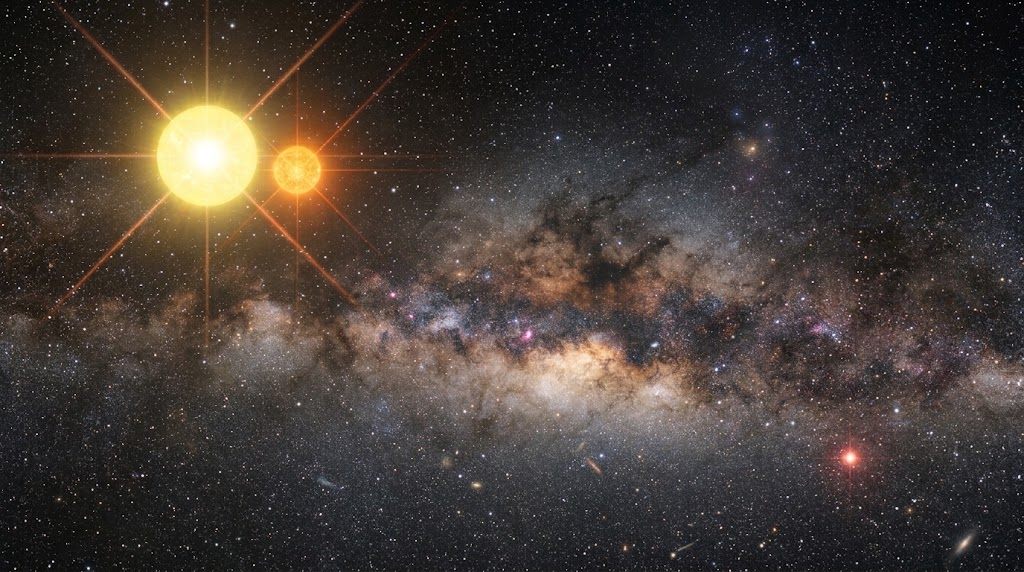
In the vast emptiness of interstellar space, where distances are measured in trillions of kilometres, one star holds a special distinction: Proxima Centauri is the closest known star to the Sun. This faint red dwarf lies about 4.24 light-years, or roughly 40 trillion kilometres, from Earth. Despite its proximity, it is far too faint to be seen with the naked eye, normally shining at around magnitude 11.13.
Proxima Centauri is a member of the Alpha Centauri triple-star system, where it is designated Alpha Centauri C. The other two stars, Alpha Centauri A and B, form a much tighter binary system about 4.37 light-years from us. Proxima currently lies roughly 13,000 astronomical units (AU) from the A-B pair, about 0.2 light-years, and follows a highly elongated orbit around them that takes approximately 550,000 years to complete.
A star hiding in plain sight
Proxima Centauri was discovered in 1915 by Scottish astronomer Robert Innes, director of the Union Observatory in Johannesburg, South Africa. He noticed a faint star with an unusually large proper motion close to Alpha Centauri. Further observations showed that it was at essentially the same distance as Alpha Centauri A and B and moving through space with them.
Innes named it Proxima Centauri, from the Latin proxima, meaning "nearest". The name was particularly appropriate: Proxima is currently our closest stellar neighbour other than the Sun.
Proxima is a red dwarf of spectral type M5.5, much smaller, cooler and fainter than the Sun. It has only about 12% of the Sun's mass and 15% of its radius, while its surface temperature is roughly 3,000 K, compared with about 5,800 K for the Sun.
Its total luminosity is only around 0.15% of the Sun's, with most of its energy emitted at infrared wavelengths. Its extremely low mass also means that it consumes its nuclear fuel very slowly. While the Sun has roughly another five billion years of hydrogen burning ahead of it, Proxima is expected to remain on the main sequence for trillions of years — perhaps around four trillion years.
A surprisingly violent star
Although Proxima is small and faint, it is far from quiet. It is a flare star, capable of sudden and dramatic increases in brightness caused by powerful magnetic eruptions. These flares can release enormous amounts of ultraviolet and X-ray radiation.
Some flares are remarkably powerful. In 2017, astronomers observed a huge outburst that caused Proxima's brightness to increase by roughly 1,000 times in only about 10 seconds. The event released intense radiation toward the planet Proxima b, which orbits extremely close to the star.
Such activity is important when considering whether planets around Proxima could support life. A planet in the star's habitable zone is exposed to much greater stellar activity than Earth receives from the Sun, and repeated flares and energetic particles could contribute to the erosion of an atmosphere.
However, the situation is more complicated than simply assuming that Proxima's planets are uninhabitable. Whether a planet can retain an atmosphere depends on many factors, including its magnetic field, atmospheric composition, geological activity and the history of its star's radiation and stellar wind.
Proxima is not evaporating
Proxima's powerful activity does produce a strong and potentially hazardous space-weather environment, but claims that the star is currently "evaporating" or losing mass 20 times faster than the Sun are not supported by the best available measurements.
Indeed, estimates of Proxima's present-day stellar-wind mass-loss rate have placed an upper limit at roughly 20% of the Sun's, although the exact value remains uncertain. The more important issue for Proxima's planets is that they orbit extremely close to the star, so they can experience a much stronger stellar-wind and radiation environment than Earth does.
Proxima's journey through space
Proxima is moving toward the Solar System at about 22 km/s relative to the Sun. Its current distance will therefore decrease for thousands of years.
Current calculations indicate that Proxima will make its closest approach to the Sun in roughly 26,000–27,000 years, when it will come to within about 3.1 light-years of us. Even then, it will remain far too faint to see with the naked eye, shining at an apparent magnitude of 10.45.
So although Proxima is our closest stellar neighbour today, it will not always hold that distinction.
Proxima Centauri b
In 2016, astronomers announced the discovery of Proxima Centauri b, the closest known exoplanet to Earth. It was detected using the radial-velocity technique, which measures the tiny wobble of a star caused by the gravitational pull of an orbiting planet.
Proxima b has a minimum mass of about 1.07 times that of Earth and completes an orbit every 11.2 days, at an average distance of only about 7.3 million kilometres from its star.
Despite being so close to Proxima, the planet lies within the star's classical habitable zone because Proxima is vastly fainter and cooler than the Sun. This means that, in principle, temperatures could permit liquid water on a suitable planetary surface.
But "habitable zone" does not mean "habitable". We do not yet know whether Proxima b has an atmosphere, oceans, a magnetic field or even a solid surface. Its close orbit also means it is probably tidally locked, although the exact rotational state depends on its orbital history.
The planet's proximity to its active red-dwarf host also exposes it to intense radiation and stellar-wind activity. Some models suggest that its atmosphere could have suffered substantial erosion over geological time. Other studies show that an atmosphere might survive under certain conditions. The question remains unresolved.
Extraordinary auroras?
The intense space weather around Proxima b could produce spectacular auroras. Models have suggested that auroral emissions could be far brighter than Earth's, potentially making them detectable with powerful telescopes.
But descriptions of planet-wide auroras that are necessarily "deadly" or thousands of times brighter than Earth's should be treated cautiously. The actual appearance and intensity would depend on the planet's atmosphere, magnetic field and the frequency and strength of stellar eruptions.
Proxima Centauri c: probably a planet, but not yet confirmed
A second possible planet, Proxima Centauri c, was identified from radial-velocity data. It appears to have a minimum mass of roughly 5.8 Earth masses, orbiting at about 1.5 AU every approximately 1,900 days (5.2 years). Its estimated equilibrium temperature is only around 39 K, making it an extremely cold world.
However, unlike Proxima b and d, Proxima c remains a candidate rather than a confirmed planet in the NASA Exoplanet Archive. Further observations have not yet established its existence beyond reasonable doubt.
If it does exist, its great distance from Proxima would make it far too cold to be considered habitable under conventional assumptions.
Proxima Centauri d: a tiny world close to its star
In 2025, astronomers confirmed the existence of Proxima Centauri d, a remarkably small planet with a minimum mass of only about 0.26 times the mass of Earth. It orbits just 0.0288 AU (about 4.3 million kilometres) from Proxima and completes an orbit in only 5.12 days. NASA classifies it as a terrestrial planet.
Despite its small size, Proxima d receives considerably more energy from its star than Earth receives from the Sun. Its estimated equilibrium temperature is around 282 K, but this does not mean its surface temperature is 282 K; the actual temperature would depend on its atmosphere and other factors. It lies well inside the star's habitable zone and is therefore not considered a likely candidate for surface liquid water.
The Proxima Centauri system
| Planet | Mass | Orbit | Distance | Status |
|---|---|---|---|---|
| Proxima Centauri b | ~1.07 Earth masses | 11.2 days | 7.3 million km | ✅ Confirmed (2016) |
| Proxima Centauri c | ~5.8 Earth masses | ~1,900 days (5.2 years) | 1.5 AU | ❓ Candidate (not yet confirmed) |
| Proxima Centauri d | ~0.26 Earth masses | 5.12 days | 4.3 million km | ✅ Confirmed (2025) |
A remarkable neighbour
Proxima Centauri is a strange combination of extremes. It is the closest star to the Sun, yet invisible to the naked eye. It is tiny compared with the Sun, yet capable of enormous flares. It may live for trillions of years, yet its planets are exposed to a hostile and highly variable environment.
And perhaps most remarkably, this inconspicuous red star has a planetary system of its own. At least two planets — Proxima b and Proxima d — are confirmed, while Proxima c remains a candidate.