Close Encounters of the Stellar Kind
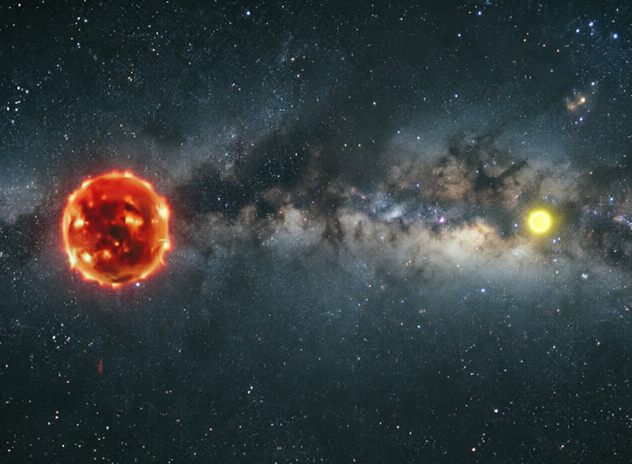
The stars overhead appear fixed and unchanging, yet nothing could be further from the truth. Every star in the Milky Way—including our own Sun—is travelling through space at tremendous speed. As these stars orbit the centre of the Galaxy, the distances between them slowly change: some drift closer while others recede into the depths of space. By tracing these stellar trajectories, astronomers can reconstruct the history of our cosmic neighbourhood and predict its future. Even so, the immensity of space means that the closest stellar encounters remain extraordinarily distant by everyday standards.
The Nearest Neighbour: Alpha Centauri
The Alpha Centauri triple system—Alpha Centauri A, Alpha Centauri B, and Proxima Centauri, a faint red dwarf—is currently the nearest stellar system to the Sun. It will remain so for tens of thousands of years. Because of their relative motion through the galaxy, Alpha Centauri A and B are still slowly approaching us. In roughly 28,000 years, the system will reach a minimum distance of about 3.2 light‑years, after which it will begin to drift away again. Even at closest approach, Alpha Centauri will remain far beyond the Oort Cloud and will have no dynamical effect on the Solar System.
Scholz's Star: A Flyby in Deep Time
Around 70,000 years ago, when both Homo sapiens and Neanderthals were roaming the Earth together, one of the closest known stellar flybys occurred. A faint binary system known as Scholz's Star (WISE J072003.20−084651.2), consisting of a small red dwarf and an even fainter brown dwarf, passed within approximately 0.8 light-years (about 52,000 AU) of the Sun. Although this seems an enormous distance, it carried the star into the outer regions of the Oort Cloud, the vast spherical reservoir thought to contain trillions of icy bodies extending nearly a light-year from the Sun.
Passing stars can gravitationally disturb these distant objects, occasionally sending some towards the inner Solar System as long-period comets. Scholz's Star probably produced only modest disturbances, but much closer encounters could trigger far larger comet showers over millions of years.
Gliese 710: The Coming Disruption
The most significant known future flyby involves Gliese 710, a K‑type orange dwarf about 60% the mass of the Sun. Current calculations indicate that in about 1.3 million years it will pass only 13,000 astronomical units (0.2 light‑years, or about 2.4 light‑months) from the Sun, carrying it deep inside the Oort Cloud. Such encounters are exceptionally rare, occurring only once every 50 million years or so.
Although Gliese 710 poses no threat to the planets themselves, its gravity is expected to disturb vast numbers of comets, sending many into elongated orbits that could eventually bring them into the inner Solar System. Even then, these comets would require millions of additional years to reach the planetary region.
Barnard's Star: Swift but Distant
Another well-known visitor is Barnard's Star, a small red dwarf in the constellation Ophiuchus. Located 5.96 light‑years from Earth, it possesses the largest known proper motion of any star in the night sky, moving more than 10 arcseconds per year against the background stars. Despite this rapid motion, Barnard's Star will never come exceptionally close. In about 10,000 years, it will approach to approximately 3.8 light‑years before beginning its slow retreat. Even at its closest, Barnard's Star will remain invisible to the naked eye, shining at magnitude ~8.5.
Ross 248 and a Curious Coincidence
Ross 248 is another star moving toward us at about 77 km/s. It is expected to make its closest approach in roughly 36,000 years, passing within about 3.0 light‑years of the Sun. Ross 248 is currently a faint magnitude 12.3 red dwarf. At its closest approach, it will brighten to approximately magnitude 9.6, still well below the threshold of naked‑eye visibility.
HD 7977: The Closest Encounter of All?
Perhaps the most fascinating case is HD 7977, a Sun‑like star that may have experienced the closest known stellar flyby in the history of the Solar System. Today it lies about 247 light‑years away and shines at magnitude 9.0. About 2.5 million years ago, however, it passed much closer. The exact distance remains uncertain because of limitations in the available data. The most likely estimate is about 13,200 AU (0.21 light‑years), although some orbital solutions allow a minimum distance of only 3,900 AU (0.06 light‑years).
If the closer estimate proves correct, HD 7977 would have produced one of the strongest gravitational perturbations ever experienced by the Solar System. Its passage would have significantly disturbed the Oort Cloud, sending vast numbers of comets into new orbits, some of which may still be entering the inner Solar System today.
The Rhythm of the Galaxy
Although dramatic stellar encounters are uncommon on human timescales, they are a normal part of the Galaxy's evolution. On average, a star passes within the outer Oort Cloud (~50,000 AU or 0.8 light-years) about once every million years. Closer sweeps within 10,000 AU are exponentially rarer, occurring roughly once every 20 to 23 million years. Over the Solar System's 4.56-billion-year history, this amounts to around 12,000 stellar flybys within 1.6 light-years. .
📊 Stellar Traffic: ~1 encounter within 50,000 AU per million years
📊 Close Calls: ~1 encounter within 10,000 AU per 20 million years
📊 Total History: ~12,000 flybys within 1.6 light‑years over 4.56 billion years
Although the stars appear fixed and eternal, they are all travellers on their own journeys around the Milky Way. Over millions of years, some drift quietly past while others pass close enough to disturb the distant Oort Cloud, occasionally sending comets towards the inner Solar System. The constellations we know today are only temporary arrangements, and the Sun's nearest neighbours will not remain the same forever. In the vast timescales of our Galaxy, the night sky is continually being reshaped, a reminder that even the seemingly unchanging heavens are part of an endless cosmic dance.