Neutron Stars
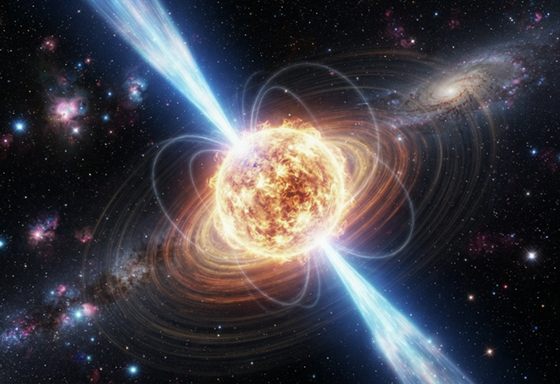
Stars operate on a delicate balance, the outward pressure of nuclear fusion fights against the inward crush of their own immense gravity. When a massive star starting out with 8 to 30 times the mass of the Sun runs out of hydrogen, it enters a desperate endgame. It begins fusing progressively heavier elements (helium, carbon, oxygen, neon, and silicon) until its core is packed with iron.
Iron is a nuclear dead end. Fusing it consumes energy rather than releasing it. The moment an iron core forms, the star’s engine cuts out, and gravity wins instantly. The core collapses inward in less than a second, hitting speeds a quarter the speed of light.
The collapse crushes atoms out of existence. Protons and electrons are smashed together, transforming into a dense ball of neutrons and unleashing a torrent of ghostly particles called neutrinos. When this collapsing ball hits nuclear density, the point where neutrons are packed shoulder-to-shoulder with zero empty space left, it becomes rigidly incompressible. The infalling material slams into this core and bounces, generating a monumental shockwave. Assisted by intense heating from the trapped neutrinos, this shockwave completely shatters the rest of the star, blowing its outer layers into space in a core-collapse supernova.
What remains is a stellar corpse: a neutron star containing roughly 1.1 to 2.3 times the mass of our Sun, compressed into a perfect sphere just 20 kilometres across, about the size of a small city. If the progenitor star is any heavier than roughly 30 solar masses, not even the stiffness of neutrons can halt the collapse, and it buckles directly into a black hole.
Impossible Density, Bizarre Interior
Because so much mass is packed into a city-sized footprint, neutron stars are the densest solid objects in the observable cosmos. To put this into perspective, a single teaspoon of neutron star material would weigh roughly 1 billion tonnes on Earth. That is equivalent to taking the entire human race, compressing us into a sugar cube, and weighing it.
The extreme environment yields a highly layered, exotic anatomy.
The Atmosphere & Crust
A ultra-thin, hyper-smooth atmosphere of hydrogen and helium floats atop a solid outer crust. This crust is a rigid, crystalline lattice of iron nuclei embedded in a dense sea of flowing electrons.
The Mantle
Deeper down, the immense pressure deforms these nuclei into bizarre, elongated sheets and tubes that physicists colloquially call "nuclear pasta" (structures resembling lasagna, spaghetti, and gnocchi).
The Core
Near the centre, all atomic boundaries dissolve completely. The material transitions into a friction-free, superconducting superfluid sea of free neutrons.
Blistering Heat and Warped Spacetime
Nuclear fusion has stopped entirely, but neutron stars remain blindingly hot. A young neutron star boasts surface temperatures exceeding 1 million degrees Celsius (hundreds of times hotter than the Sun). This is not generated by an active furnace, but is the leftover kinetic and gravitational heat trapped from the star's cataclysmic birth. As they have very little surface area to radiate this energy away, they take millions of years to cool down. This concentrated mass severely warps the fabric of space and time around it.
Crushing Gravity: A neutron star's gravity is roughly 200 billion times stronger than Earth's. If you dropped an object from a few centimetres above the surface, it would impact the ground at millions of kilometres per hour, instantly obliterating into a soup of subatomic particles.
Gravitational Lensing: The gravity is so intense that it bends light rays around the star like a lens. If you were looking at a neutron star, you wouldn't just see the front hemisphere; the gravity would bend light from the far side, allowing you to see the front and parts of the back simultaneously.
Time Dilation: Space-time is so heavily warped that time passes noticeably slower on the surface. A clock placed on a neutron star would lose a few seconds every day relative to an identical clock floating far away in deep space.
Pulsars: Cosmic Lighthouses
Neutron stars rotate at mind-boggling speeds due to the conservation of angular momentum, the same physics principle that causes a spinning figure skater to accelerate when they pull their arms inward. When a giant star spinning once a month collapses down to the size of a city, its rotation speed skyrockets. Neutron stars can spin anywhere from once a second to over 700 times per second. As they spin, their compressed, highly concentrated magnetic fields accelerate charged particles, blasting narrow, intensely bright beams of radiation (ranging from radio waves to X-rays) out of their magnetic poles. Because a star's magnetic axis is rarely perfectly aligned with its rotational axis, these beams sweep across the cosmos like a lighthouse. If Earth happens to lie directly in the path of this sweeping beam, our telescopes detect a highly rhythmic, ticking pulse of energy. We call these precise, rotating clocks pulsars.
Magnetars and Mega-Starquakes
While a standard neutron star possesses a magnetic field trillions of times stronger than Earth's, a rare subset known as magnetars possess fields a thousand times stronger still. They are the most powerful magnetic engines in the known Universe. A magnetar’s field is so strong that if one were parked halfway between Earth and the Moon, it would instantly wipe every credit card and magnetic hard drive on Earth. If you ventured within a few thousand kilometres of one, its magnetic forces would physically distort the electron clouds surrounding your atoms, and instantly dissolving your body's chemistry. This intense magnetic tension places unimaginable stress on the magnetar's solid iron crust. As the internal magnetic field lines twist and shift, the crust eventually cracks under the pressure. This causes a cataclysmic starquake.
When a magnetar's crust breaks, it releases a sudden, blinding flash of high-energy gamma rays called a magnetar giant flare. These flares are so luminous they can outshine an entire galaxy. During a famous event on December 27, 2004, a starquake on a magnetar named SGR 1806-20 released more energy in just one-tenth of a second than our Sun emits across 150,000 years, briefly blinding space telescopes across the solar system despite being located 50,000 light-years away.
Kilonovae: Forging the Wealth of the Universe
Neutron stars often exist in pairs, orbiting one another. As they circle, they churn space-time, losing orbital energy by radiating ripples known as gravitational waves. As they shed energy, they slowly spiral closer and closer together until they inevitably collide. The resulting cosmic merger triggers a phenomenal explosion called a kilonova. The impact violently sprays super-dense, neutron-rich material out into the vacuum of space. In this chaotic, high-energy environment, free neutrons rapidly bombard atomic nuclei, forcing them to grow into heavier elements via a process called rapid neutron capture. This is the primary cosmic forge for the heaviest elements on the periodic table, including gold, platinum, and uranium.
In fact, astrophysicists calculate that nearly all the gold found on Earth was cooked inside ancient kilonova explosions billions of years ago before being swept up into the cloud that formed our solar system. In 2017, scientists successfully detected both the gravitational waves and the light from a neutron star collision, definitively proving that the jewellery we wear was forged in the wreckage of colliding stellar corpses.
Neutron stars serve as nature's most extreme physics laboratories, packing the mass of a sun into the size of a city. Born from the spectacular deaths of massive stars, these ultra-dense remnants push gravity, magnetism, and time to their absolute breaking points. Whether flashing across space as ticking pulsars, fracturing violently as hyper-magnetic magnetars, or colliding in catastrophic kilonovae. Far more than just stellar corpses, they are the primary cosmic forges that created the universe's heaviest precious metals, the very gold we wear on Earth was forged in the wreckage of dead stars.