Ancient Chinese Astronomy: 3,000 Years of Celestial Records
Ancient Chinese astronomy stands as one of the oldest continuous astronomical traditions in the world — a magnificent unbroken thread of observation spanning more than three millennia. While other civilizations watched the sky, China's astronomers meticulously recorded everything they saw, creating a treasure trove of celestial data that modern scientists still rely upon today.
Oracle Bones: The Earliest Evidence
The earliest written evidence of Chinese astronomy comes from an unexpected source: oracle bones. Unearthed at Anyang and dating from approximately 1250 to 1050 BCE, these ox shoulder blades and turtle shells reveal that Shang Dynasty diviners closely watched the heavens. They meticulously observed, recorded, and interpreted celestial phenomena to predict future events, believing the sky held messages about harvests, warfare, and the fate of the kingdom.
These ancient inscriptions include remarkable records of lunar eclipses, solar eclipses, star sightings, comets, unusual celestial events, and weather patterns. For the Shang rulers, this information was not merely academic — it was crucial for both agricultural planning and maintaining political order.
Imperial Astronomers: Guardians of the Sky
Chinese astronomers were meticulous record-keepers. Over centuries, this practice became highly organised under imperial court astronomers, who held the solemn responsibility of watching the sky every single night. These court officials were not mere observers — they were trusted advisors whose interpretations of celestial events could influence imperial decisions.
A Different Way of Seeing the Sky
By the 4th century BCE, Chinese scholars had developed a unique framework for understanding the heavens. Instead of the 88 constellations recognized in Western astronomy today, they divided the sky into 28 "lunar mansions" — a system based on the Moon's daily movement against the background stars. This elegant framework allowed them to track planetary motions, eclipses, and seasonal changes with remarkable precision.
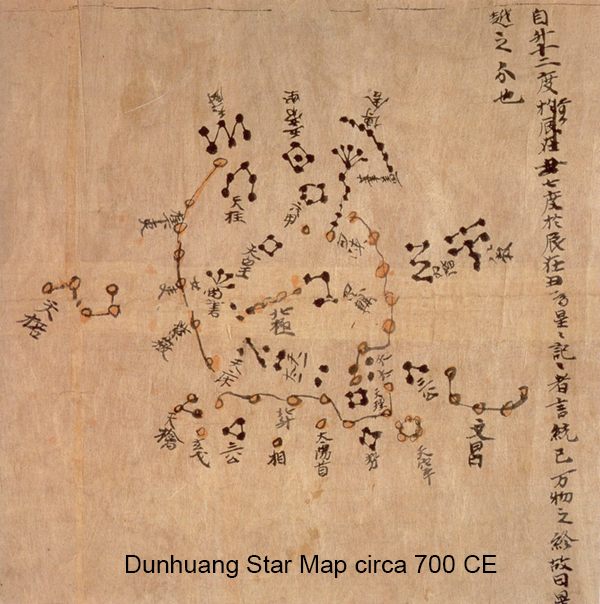
The world's oldest surviving star atlas comes from Dunhuang, dating to approximately 700 CE. But even more impressive is the earlier work of Shi Shen and Gan De in the 4th century BCE, who catalogued over 800 stars. Shi Shen's star catalogue predates the famous work of Hipparchus by two centuries, yet it remains far less known in the West.
Phenomena That Shook the World
Chinese astronomers recorded comets, novae, supernovae, sunspots, and planetary motions with remarkable consistency. Some of these records are among the earliest known observations of such phenomena in all of human history. While other civilizations occasionally noted celestial visitors, China's astronomers systematically tracked and described them.
Halley's Comet: A 2,000-Year Paper Trail
The earliest confirmed Chinese comet observation dates to 613 BCE, recorded in the Spring and Autumn Annals (Chūnqiū 春秋), the official chronicle of the State of Lu. But the most fascinating example involves Halley's Comet. In 240 BCE, during the Warring States period (475–221 BCE), astronomers recorded the appearance of a comet — and this is particularly exciting because it represents the earliest apparition that modern astronomers can confidently match to Halley's orbit. Historical Chinese records are so precise that scientists can use them to calculate the comet's orbital evolution over two millennia!
Supernovae: Cosmic Explosions Witnessed
During the Han Dynasty (202 BCE–220 CE), Chinese astronomers recorded the earliest clearly documented supernova in history — SN 185, which appeared in 185 CE. This was followed by spectacular records of subsequent supernovae, including:
SN 1006 (1006 CE): The brightest supernova in recorded history — sixteen times brighter than Venus and possibly visible in daylight.
SN 1054 (1054 CE): The explosion that created the Crab Nebula, documented so precisely that modern astronomers can pinpoint its date.
SN 1181 (1181 CE): A less famous but equally important stellar explosion, also faithfully recorded.
The Sacred Calendar: Keeping Time with the Cosmos
Ancient Chinese astronomers were directly responsible for devising and maintaining the Chinese calendar. Together with timekeeping, this responsibility was central to their role in society. Historical evidence shows that as early as the Xia and Shang dynasties, Chinese astronomers were already using sophisticated methods to reconcile lunar months with the solar year.
Because the Chinese calendar is lunisolar (based on both the Moon's phases and the Sun's position), astronomers had to track both the Moon's monthly cycle and the Sun's annual motion through the stars. This was necessary to keep the months and seasons properly aligned — essential for agriculture and festival observances.
Since the lunar cycle (approximately 29.5 days) does not align perfectly with the solar year (approximately 365.25 days), Chinese astronomers introduced intercalary months — essentially "leap months" added to lunisolar calendars to realign them with the seasons. This required continuous observation, careful calculation, and periodic correction. Getting it wrong could disrupt harvests and anger the heavens.
Astronomy as Statecraft: The Mandate of Heaven
Astronomy in ancient China was tightly linked to the state — perhaps more closely than in any other civilization. The emperor was considered the "Son of Heaven," and the heavens were believed to reflect the stability and righteousness of his rule. A peaceful, orderly sky meant a peaceful, orderly empire. But unexpected events told a different story.
As a result, astronomers held an important bureaucratic position at court. Celestial events such as eclipses or comets were interpreted as omens. A solar eclipse might signal disorder or moral failing in the empire, while an unexpected comet could be seen as a warning of political change or even the fall of a dynasty. Because of this, accurate prediction of eclipses was extremely important — both scientifically and politically. A court astronomer who failed to predict an eclipse was not merely wrong; he had potentially endangered the empire.
The Legend of Xi and He: A Cautionary Tale
The position of court astronomer was highly prestigious and held in extremely high regard. These officials alone could interpret the will of the heavens — a power that came with great status but also enormous responsibility.
There is a fanciful story, likely apocryphal but revealing nonetheless, that two royal astronomers named Xi and He were executed for failing to predict a solar eclipse. According to the ancient text Shujing (书经, Book of Documents), during the reign of Emperor Zhong Kang of the Xia Dynasty (circa 2000 BCE), the astronomers Xi and He neglected their duties. The most colorful versions of the tale claim they were drunk or debauched and failed to predict a solar eclipse, which caused panic among the people. For this negligence, they were executed. Whether true or legend, the story powerfully illustrates how seriously ancient Chinese society took the duty of watching the sky.
Legacy: A Gift to Modern Science
Ancient Chinese astronomy was a unique blend of science and statecraft. Driven by the philosophy of the Mandate of Heaven, astronomers served as essential imperial officials, interpreting omens and creating sacred calendars. But their legacy extends far beyond the court.
Modern astronomers and astrophysicists continue to rely upon China's meticulous, continuous records of comets, eclipses, sunspots, and supernovae. These three-millennia-long observations help scientists understand long-term celestial patterns, refine orbital calculations, and even study the history of our galaxy. When a supernova remnant is studied today, Chinese records often provide the most accurate historical date for when the original star exploded.
The ancient Chinese astronomers did not merely watch the sky — they preserved its story. And because of their dedication, we can still read that story today, three thousand years later.