Chasing the thinnest crescent moon
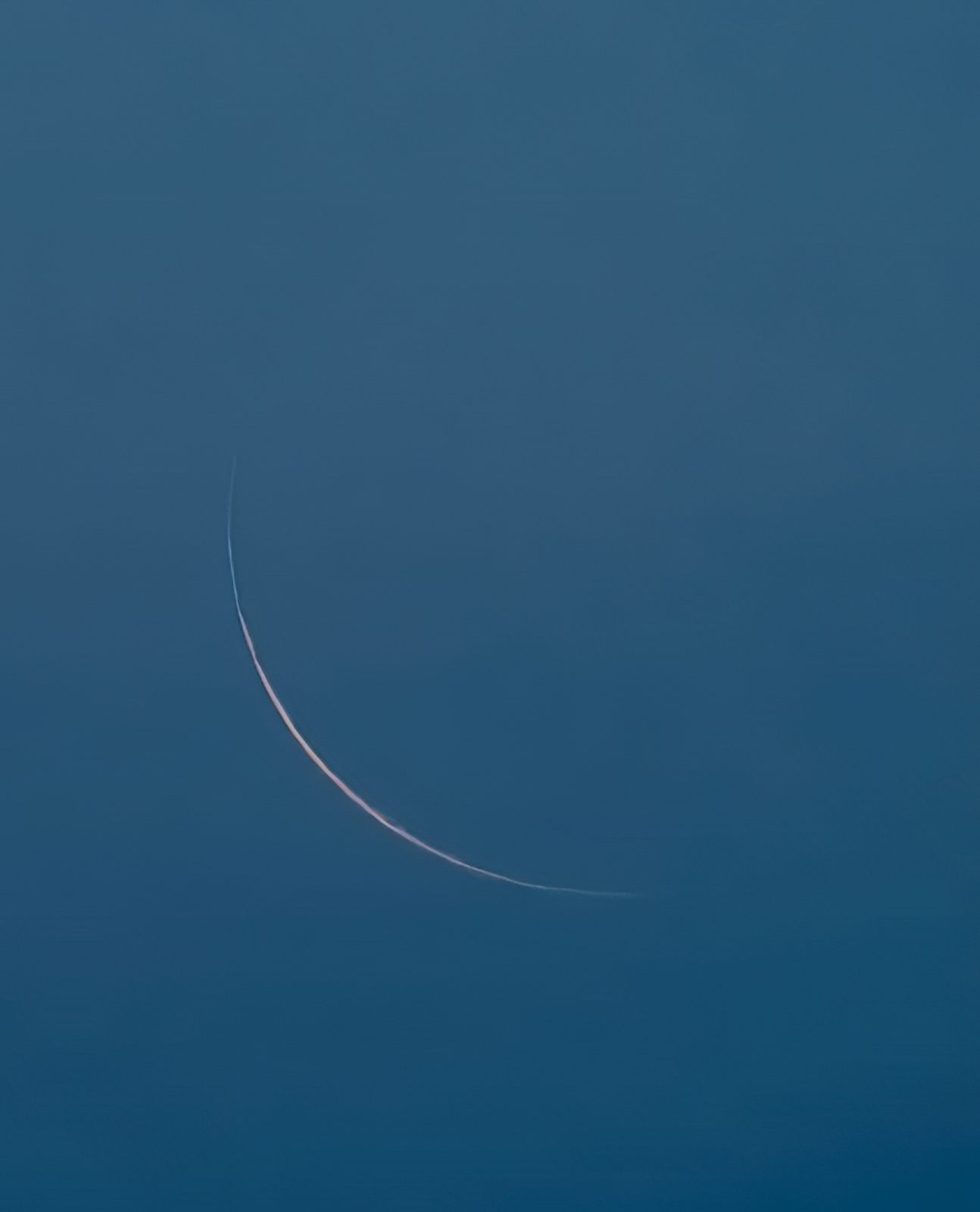
Observing the thinnest crescent Moon is a classic challenge in observational astronomy, often called the “young Moon” hunt. It is accessible to amateurs with modest equipment, but it rewards careful planning, patience, and good atmospheric conditions.
Finding the thin crescent
At minimum, you need a clear, unobstructed horizon—free of cloud, haze, smoke, or bright city glare. Binoculars greatly improve your chances, especially in the first attempt or under less-than-ideal twilight conditions. A small telescope can help, but it is not essential.
Planetarium software such as Stellarium (available on computers and iOS/Android) is extremely useful for predicting where and when the Moon will appear. Bright planets such as Venus, Jupiter, or sometimes Mercury can also act as visual guides when they appear close to the Moon in the sky.
The general rule is simple:
- Look low in the western sky after sunset for a young crescent (just after new moon).
- Look low in the eastern sky before sunrise for a very old crescent (just before new moon).
The best time is during bright twilight—typically 20–40 minutes after sunset or before sunrise—when the sky is still bright but the Sun is safely below the horizon.
Why it is so difficult
The difficulty of seeing a very thin crescent Moon is mainly due to its proximity to the Sun in the sky. When the Moon is very close in angular separation (called elongation), its faint reflected light is overwhelmed by solar glare and atmospheric scattering.
As a general guide, the Moon is usually extremely difficult to detect when its elongation is below about 7° from the Sun. This is sometimes associated with the Danjon limit, although the exact threshold varies with atmospheric clarity, observer experience, and optical aid.
Another important factor is that the Moon's orbit is tilted about 5° relative to Earth's orbital plane (the ecliptic). This tilt determines how high or low the Moon appears above the horizon shortly after sunset or before sunrise.
Seasonal geometry and visibility
The visibility of very thin crescents also depends strongly on the angle the ecliptic makes with the horizon:
- When the ecliptic is steep, the Moon climbs higher above the horizon in a short time, placing it in a darker sky and making it easier to see.
- When the ecliptic is shallow, the Moon stays closer to the horizon in bright twilight, making it harder to detect.
In the Southern Hemisphere:
- Spring (September–November): morning crescents (before sunrise) are generally better placed and easier to observe.
- Autumn (March–May): evening crescents (after sunset) are generally more favourable.
This seasonal effect is one reason why lunar crescent visibility varies significantly throughout the year.
Record‑breaking observations
One of the most extreme photographic captures was achieved by astrophotographer Thierry Legault on July 8, 2013. He successfully imaged the Moon at an age of essentially 0 hours, meaning it was at the instant of new moon. This required advanced techniques, including precise solar filtering, daytime imaging, and digital stacking and processing. At this stage, the Moon is not visible in a conventional sense, so the result represents the limit of modern imaging rather than direct visual observation.
The record for the youngest crescent observed with optical aid is attributed to Mohsen G. Mirsaeed, who reported a sighting on September 7, 2002, at an age of 11 hours and 40 minutes after new moon. He used powerful 40×150 binoculars and observed from a high-altitude site (about 2,110 metres above sea level) in Zarand, Iran. The elevation reduced atmospheric scattering and dust, significantly improving contrast near the horizon where very young crescents are usually seen.
The record for the youngest crescent seen with the unaided eye is credited to Stephen James O'Meara, who observed it on May 24, 1990, at an age of 15 hours and 32 minutes after new moon, from the slopes of Kīlauea volcano in Hawaii. The site's high altitude and very dark skies were important contributing factors.
O'Meara is also widely regarded as having exceptionally sharp visual acuity. Reports and observing accounts suggest that under ideal dark-sky conditions he could detect stars down to about magnitude 7 to 8 with the naked eye, whereas the typical human limit under excellent conditions is around magnitude 6.
Conclusion
Chasing the thinnest crescent Moon is more than a technical challenge—it is a quiet celebration of patience, preparation, and the subtle beauty of the night sky. While record-breaking sightings require exceptional conditions or advanced equipment, the joy of spotting any young crescent with binoculars or even the naked eye is within reach of most dedicated observers. Whether you succeed on your first attempt or your tenth, each hunt deepens your connection to the rhythms of the solar system. So find a clear western horizon, check your planetarium app, and step outside during twilight. The thinnest crescent is waiting—if you know when and where to look.