Guide to buying binoculars
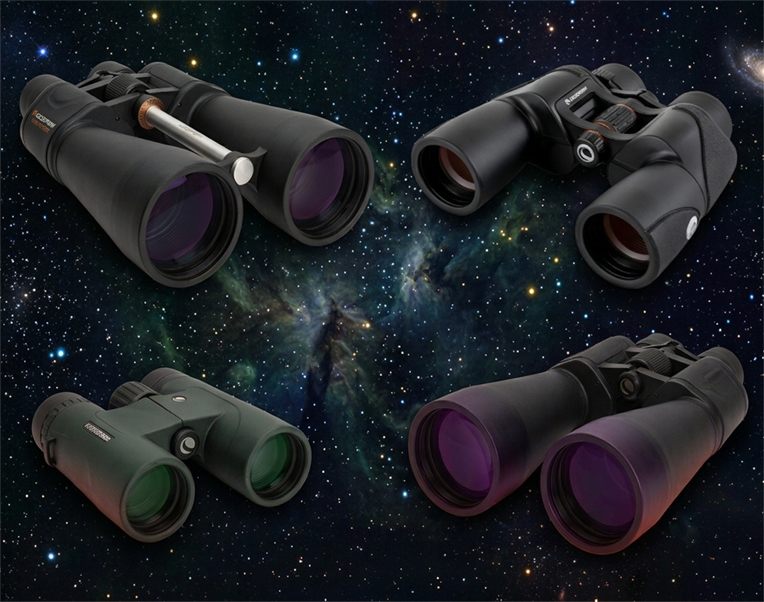
Ask someone who has just decided to take up astronomy what they should buy first, and almost everyone will say a telescope. But ask any seasoned stargazer, and they’ll likely give you a different piece of advice, start with a good pair of binoculars. They are intuitive, lightweight, affordable, and wonderfully portable, perfect not only for beginners but also for seasoned observers who appreciate simplicity and wide‑field views. Choosing the right pair, however, can feel overwhelming, with countless specifications and models competing for attention. This guide explains the essentials so you can select binoculars that genuinely enhance your night‑sky experience.
Understanding the Numbers: Magnification and Aperture
Every pair of binoculars is identified by two numbers, such as 7×50 or 15×70. The first number is the magnification. It tells you how many times larger or closer an object appears compared with the unaided eye. At 7× magnification, an object 70 metres away appears as though it were only 10 metres away. With 15× binoculars, the same object appears approximately 4.7 metres away.
At first glance, it might seem that higher magnification is always better, but it comes with two important disadvantages. First, higher magnifications are much more difficult to hold steady by hand, causing image shake. Secondly, increasing magnification usually reduces the true field of view, making it more difficult to locate celestial objects. For these reasons, binoculars in the 7× to 10× range are ideal for hand-held astronomy. Many experienced amateur astronomers consider 10×50 binoculars to offer the best balance between magnification, light-gathering ability and portability.
The second number is the aperture—the diameter of the objective (front) lens, measured in millimetres. For astronomical observing, aperture is arguably the most important specification. The larger the objective lenses, the more light they collect, allowing you to detect fainter stars and deep-sky objects such as nebulae and galaxies.
As a rough guide, under dark rural skies (Bortle 2–3), a typical 7×50 binocular reaches around magnitude 9.5–10, while a 15×70 can reach roughly 11–11.5. Aperture is not the only determining factor; the higher magnification of a 10×50 often allows it to reach around half a magnitude fainter than a 7×50, despite having the same aperture.
Exit Pupil: Matching the Instrument to Your Eyes
To understand whether your binoculars will use all the light they collect, you need to understand the exit pupil. This is the diameter of the beam of light that exits the eyepiece and enters your eye. It is calculated by dividing the objective diameter by the magnification.
7×50: 50 ÷ 7 = 7.1 mm
15×70: 70 ÷ 15 = 4.7 mm
The usefulness of the exit pupil depends on the diameter of your own eye's pupil after full dark adaptation. Age has a significant effect. A healthy person in their twenties may achieve a dark-adapted pupil of around 7 mm, whereas someone in their seventies may reach only 5 mm, although there is considerable variation between individuals.
If the binocular's exit pupil is larger than your dark-adapted pupil, your iris blocks the outer part of the light beam and some of the light never enters your eye.
The effective aperture is calculated as: Effective aperture = Magnification × Your pupil diameter.
For example, if your fully dark-adapted pupil measures 5 mm, a 7×50 binocular (with a 7.1 mm exit pupil) cannot deliver its full beam of light to your eye. The outer portion of the light beam is blocked by the iris, reducing the effective aperture. Since the effective aperture equals the magnification multiplied by the eye's pupil diameter, the binocular effectively operates as a 7×35 (7 × 5 = 35 mm). As only the central 35 mm of the 50 mm objective lens contributes to the image, your 7×50 is effectively behaving like a 7×35 binocular.
Field of View: Seeing More Sky at Once
Equally important is the field of view (FOV), usually expressed in degrees. A wide field makes it much easier to locate celestial objects and provides spectacular views of large objects such as the Pleiades, the Eta Carina Nebula, the North American Nebula, and the rich star fields of the Milky Way. For astronomical use, a true field of view between 5° and 7° is generally ideal.
Optical Quality: Coatings, Prisms, and Glass
Optical quality is just as important as size. Look for binoculars with fully multi-coated optics, which maximise light transmission and minimise unwanted reflections.
Binoculars also contain prisms that invert the image so it appears the correct way up. There are two main prism designs.
Porro-prism binoculars have the familiar zigzag shape. They are generally preferred by astronomers because they usually provide brighter images, excellent stereoscopic depth, wider fields of view, and better performance for the price.
Roof-prism binoculars have straight barrels, making them more compact and easier to carry. However, producing roof prisms with optical performance equal to Porro prisms requires more complex manufacturing, so high-quality roof-prism binoculars are generally more expensive.
For the glass itself, seek out BAK-4 prisms, which typically produce brighter, sharper images than the less expensive BK-7 prisms, particularly towards the edge of the field.
Eye Relief and Comfort
If you wear glasses while observing, eye relief becomes essential. It is the distance your eye can be from the eyepiece while still seeing the full field. For spectacle wearers, choose a model with at least 15–20mm of eye relief. If you don't wear glasses, you can comfortably manage with 10–14mm.
Weather Protection
Since astronomical binoculars are often used at night when dew is common, waterproof binoculars that are nitrogen-filled and O-ring sealed are well worth considering. They help prevent internal fogging and provide excellent protection against moisture and dust.
Focusing
Before buying binoculars, check the focusing mechanism. A smooth, precise centre-focus wheel makes observing much easier. Avoid fixed-focus or so-called "autofocus" binoculars for astronomy. Also ensure the right eyepiece has a dioptre adjustment to compensate for differences in vision between your two eyes.
Weight
Finally, consider the weight. Ask yourself whether the binoculars are comfortable to hold for extended observing sessions. A lighter 10x50 (around 900g) is perfectly comfortable to hand-hold for extended sessions. If you choose larger models, such as 15×70, a sturdy tripod and binocular adapter are essential for obtaining steady, enjoyable views.
Final Thoughts
For most beginners, a high-quality 10×50 binocular with fully multi-coated optics, BAK-4 prisms, and a Porro-prism design represents an excellent starting point. They are light enough to be comfortably hand-held, collect sufficient light to reveal hundreds of deep-sky objects, and provide a wide, immersive view of the night sky.
Ultimately, the best binoculars are not necessarily the biggest or the most expensive—they are the pair that feels comfortable in your hands and encourages you to spend more nights under the stars. A binocular that you enjoy using regularly will always provide more rewarding observing than one that spends its life on a shelf.