Rogue Planets – The Lonely Wanderers of the Galaxy
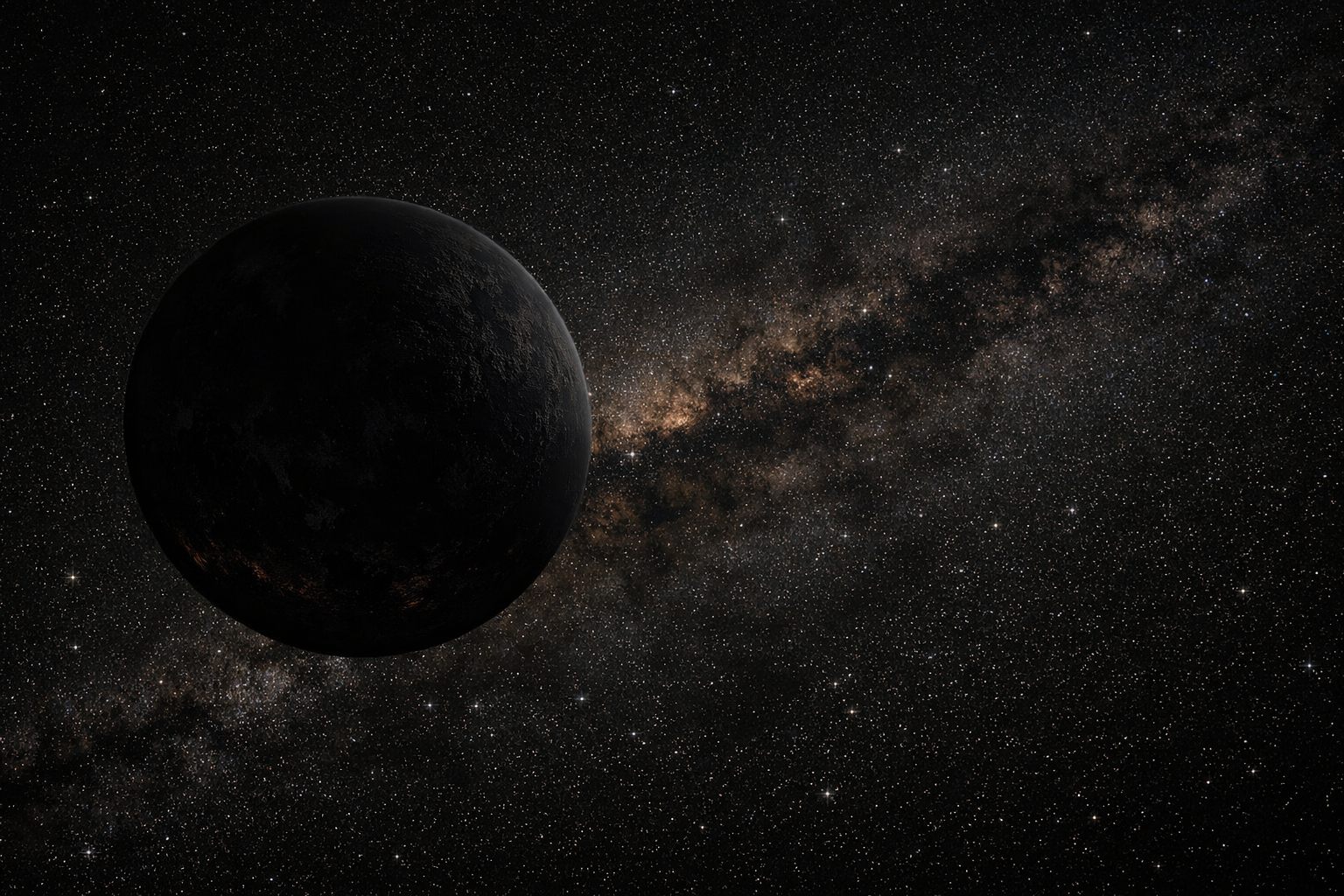
Imagine a planet drifting alone through the darkness of interstellar space, with no sunrise, no sunset and no parent star to provide warmth or light. These mysterious worlds, known as rogue planets or free-floating planets, are among the most elusive objects in the Universe.
Unlike the planets in our Solar System, rogue planets do not orbit a star. Instead, they travel independently around the centre of the Milky Way, following their own galactic orbits. Some may have spent billions of years wandering the vast distances between the stars.
How Do Rogue Planets Form?
Astronomers believe that many rogue planets begin life in ordinary planetary systems. During the chaotic early stages of a system's formation, newly formed planets can interact gravitationally with one another. Close encounters between massive planets may eventually fling one of them completely out of its home system, sending it into interstellar space.
Planetary systems can also become unstable much later in their lives. Changes in planetary orbits, encounters with passing stars, or the complex gravitational interactions that occur in binary star systems can occasionally eject planets long after they have formed.
Not every rogue planet was necessarily expelled from a planetary system. Some may have formed directly from collapsing clouds of gas and dust, in much the same way as stars, but without accumulating enough mass to ignite nuclear fusion. These objects blur the boundary between giant planets and brown dwarfs.
How Many Are There?
No one knows exactly how many rogue planets exist. Because they emit little or no visible light, they are extraordinarily difficult to detect.
Gravitational microlensing surveys have revealed that free-floating planets may be surprisingly common. Some studies suggest there could be many billions, or even trillions, of rogue planets in the Milky Way. One recent estimate proposes there may be as many as 20 rogue planets for every star in our Galaxy, although this figure remains uncertain and is still being tested by future observations.
Current evidence also suggests that small rogue planets may be more numerous than giant planets like Jupiter. If so, Earth-sized worlds could make up a significant fraction of the Galaxy's wandering planetary population.
How Are Rogue Planets Discovered?
Finding a rogue planet is a considerable challenge. Since these worlds have no nearby star to illuminate them, they are usually too faint to be seen directly.
Astronomers therefore rely on a technique known as gravitational microlensing. When a rogue planet passes almost exactly in front of a distant background star, the planet's gravity acts as a natural lens, briefly magnifying the star's light. Microlensing events caused by Earth‑mass rogue planets typically last hours, while Jupiter‑mass events last 1–2 days. By analysing these events, astronomers can estimate the mass and abundance of rogue planets throughout the Galaxy.
Could Rogue Planets Support Life?
Although most rogue planets would be extremely cold, they may not all be frozen wastelands. If a rogue planet retained a thick atmosphere rich in hydrogen or possessed internal heat generated by radioactive decay or tidal forces before its ejection, it is possible that liquid water could exist beneath an insulating layer of ice.
Such environments remain entirely hypothetical, but they demonstrate that a planet does not necessarily require sunlight to maintain regions where life might survive.
Are Rogue Planets Dangerous?
The idea of a rogue planet wandering into the Solar System has often appeared in science fiction, but astronomers consider the risk to be extremely small. Space between the stars is unimaginably vast, making close encounters exceedingly rare. The probability of a rogue planet passing within 1 AU of the Sun is astronomically small — far lower than the chance of a nearby supernova or gamma‑ray burst.
Even if a rogue planet passed through the outer Solar System, it would most likely continue on its way with little effect. Only an exceptionally close approach by a massive object would significantly disturb the orbits of the planets, and the probability of such an event occurring in the foreseeable future is extraordinarily low.
The Future of Rogue Planet Research
The coming decade promises major advances in our understanding of rogue planets. NASA's Nancy Grace Roman Space Telescope, together with ground-based observatories such as the Vera C. Rubin Observatory, will conduct large microlensing surveys capable of discovering hundreds of previously unknown free-floating planets.
These observations will help astronomers determine how common rogue planets really are, measure their masses more accurately, and reveal whether our Galaxy contains a hidden population of lonely worlds that vastly outnumber the planets orbiting stars.
Once considered little more than a theoretical curiosity, rogue planets are now recognised as an important part of our Galaxy. As new telescopes begin exploring this hidden population, these solitary wanderers may prove to be among the most numerous planetary objects in the Milky Way.