Eta Carinae: A Star Waiting to Explode
The η Carinae Nebula is a massive complex area of bright emission dark nebulosity located approximately 7,500 light years from Earth in the constellation Carina. It is one of the largest diffuse nebulae in Earth's sky. Although it is four times as large as and even brighter than the famous Orion Nebula, the Carina Nebula is much less well known due to its location in the southern sky.
A Hypergiant Star
Within the nebula is η Carinae, a highly luminous hypergiant star. Its mass is estimated to be 100 to 150 times the mass of the sun and its luminosity about 4 million times that of the sun. For comparison if it were to take the position of our Sun, it is so large that its outer layers would extend far beyond the orbit of Mars, possibly even approaching Jupiter depending on which layer you define as the 'surface'. Pluto would receive about 3,300 times more light than Earth currently gets from our Sun. In other words, Pluto's sky would be dazzlingly bright and the surface vastly hotter than present day Earth. To get Earth-like sunlight levels from η Carinae you would need to move out to roughly 2200 AU (0.035 light years or about 329 billion kilometres) away.
Historical Brightening Events
Previously a 4th magnitude star, historical records do show that in 1837 Eta Carinae underwent an unusual outburst that made it one of the brightest stars in the southern sky. It outshone Rigel, briefly becoming the second-brightest star in the night sky at about magnitude −1 between 11 and 14 March 1843, before gradually fading and dropping below naked-eye visibility after 1856. In a smaller eruption, it reached 6th magnitude in 1892 before fading again. It has brightened consistently since about 1940, becoming brighter than magnitude 4.5 currently. Today much of its light is obscured by surrounding dust and gas from that eruption. Without the obscuring nebula, it would appear substantially brighter.
A Future Supernova
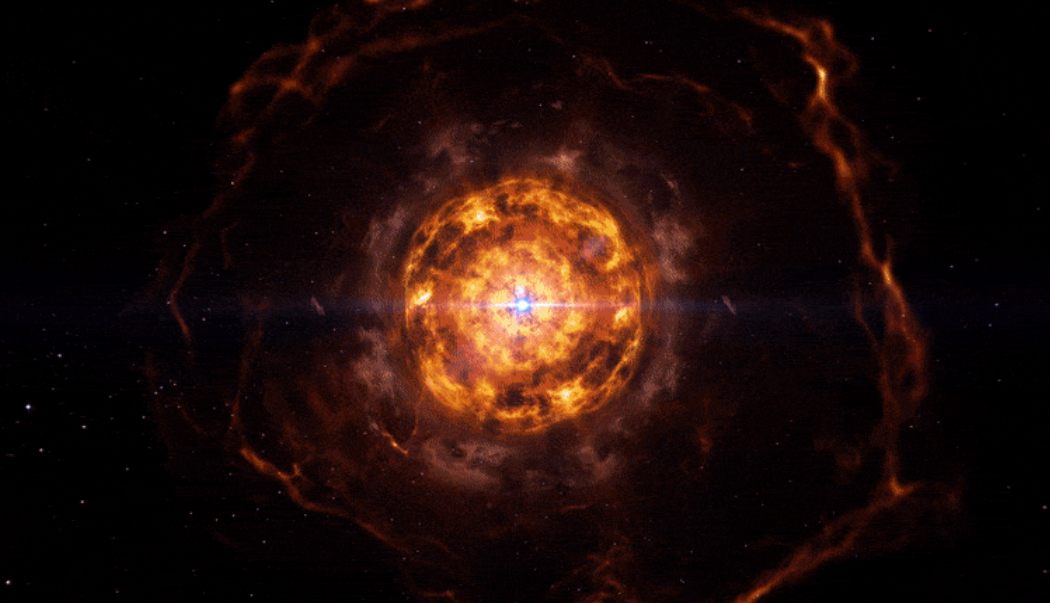
η Carinae Nebula being highly unstable is one of the best-known supernova (or even hypernova) candidates in our galaxy. No one knows when it may explode, it may already have exploded but its light have not reached us yet, or it may be one million years from now. When it explodes it will be spectacular. At the peak of the explosion it could reach magnitude -12 to -20 or brighter. The southern night sky would be transformed. Shadows would be cast at night, the sky would take on a permanent twilight glow. It would be visible clearly during the day for weeks or months. For lucky observers this would be the brightest star-like event in recorded history, a 'once-in-civilisation' astronomical spectacle. Despite its magnificent appearance, its distance of about 7,500 light-years ensures it would pose no danger to Earth.