Gān Dé & Shí Shēn: The Founding Fathers of Chinese Astronomy
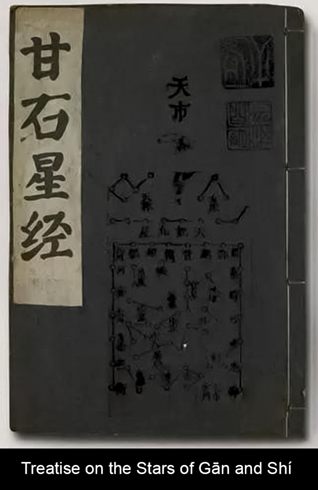
Much has been written about ancient Greek astronomers such as Aristarchus, Eratosthenes, Hipparchus, and Ptolemy. Far less familiar to Western readers are their Chinese counterparts, including Gān Dé (甘德), Shí Shēn (石申), Zhāng Héng (张衡), and Guō Shǒujìng (郭守敬). Among these early pioneers, Gān Dé and Shí Shēn occupy a special place as the founding figures of Chinese astronomy, and it is their achievements that we shall examine here.
The Warring States Astronomers
Although both were regarded as contemporaries, in the sense that they were both active in the same historical period, during the Warring States era (475 BC to 221 BC), they almost certainly never met. Gān Dé served as a court astronomer in the eastern State of Qí (齐国), while Shí Shēn worked in the State of Wèi (魏国) in the central plains. Constant warfare and restricted travel between rival states made personal contact unlikely. Despite this separation, history has permanently linked their names as the earliest great astronomers of China.
Gān Dé: Observer of Planets and a Mysterious Jovian Moon
Gān Dé was born sometime between 400 and 340 BCE. Little is known about his life. Despite the turbulent political climate, he produced some of the earliest systematic astronomical records in world history. His most important contribution was the compilation of a star catalogue and astronomical treatise, among the oldest known in the world. Working entirely without optical instruments, he recorded the positions and characteristics of numerous stars and grouped them into constellations that reflected the bureaucratic, social, and cosmological order envisioned by ancient Chinese society.
Gān Dé also made great achievements in the study of planetary motion. He discovered the retrograde motion of Mars and Venus and proposed the concept of the synodic period (the time it takes for a planet, moon, or other object to return to the same position in the sky as seen from Earth). Although his observations were relatively rudimentary, they represented the advanced level of planetary research in the Warring States period and opened up an important reference for later generations studying the night sky.
One of his most intriguing records concerns Jupiter, known as the “Year Star” (岁星 Suìxīng). In 365 BCE, he reported that Jupiter was accompanied by “a small reddish star.” Some modern scholars have suggested that this object may have been Ganymede, Jupiter's largest moon. If so, Gān Dé would have observed a Jovian satellite nearly two thousand years before Galileo Galilei's telescopic discoveries of 1610. However, this interpretation remains speculative and is not universally accepted. It must be said that occasionally, a sharp eye under exceptionally dark skies may glimpse one or two of the brightest moons without optics, but this is rare and unreliable because Jupiter’s glare overwhelms them.
Shí Shēn: The First Star Catalogue in History
Shí Shēn, a contemporary of Gān Dé, was equally distinguished. He systematically observed the sky and recorded the positions of 121 stars, covering 138 constellations and totaling 810 stars. His most significant achievement is the world's oldest known star catalogue. His Shí's Star Catalogue (石氏星表 Shí shì xīng biǎo) was compiled around 355 BCE. According to a 2025 study, this was over 200 years before the Greek astronomer Hipparchus. Using early forms of celestial coordinates, it provided detailed positions of 120 stars, establishing a systematic mapping of the night sky. The title "Father of China's Star Catalogue" (中国星表之父 Zhōngguó xīng biǎo zhī fù) is most often attributed to Shí Shēn.
Beyond star mapping, Shí Shēn's insights were remarkably diverse. He is credited with one of the earliest deliberate observations of sunspots, and he discovered the retrograde motion of Mars — overturning the assumption that planets always moved in one direction — and the variation in the Moon's speed and that its orbit deviates from the ecliptic. He also proposed the correct theory that solar and lunar eclipses are caused by celestial bodies shadowing one another.
Four Foundational Contributions of Shí Shēn
📐 Earth’s axial tilt: He measured the obliquity of the ecliptic to understand the changing seasons — a crucial step for calendar science.
🌙 Lunar motion: He recognized that the Moon’s speed varies and that its orbit is inclined relative to the ecliptic, explaining why eclipses do not happen every month.
⏳ Jupiter Year Cycle Method: Using Jupiter’s 12-year orbit, he created a simple cycle for naming years (岁星纪年法 Suì Xīng Jì Nián Fǎ).
📆 Quarter Remainder Calendar (四分历): He established a year length of 365¼ days and added a leap day every four years, keeping the calendar aligned with the seasons — remarkably similar to the later Julian system.
The Lost Treatises & The Gān Shí Classic
The original astronomical treatises by Gān Dé and Shí Shēn were separate. Gān Dé authored an eight-volume work called Astronomical Star Prognostication (天文星占 Tiānwén xīng zhān), while Shí Shēn wrote Astronomy (天文 Tiānwén), which was later known as Shí's Classic of Stars (石氏星经 Shí shì xīng jīng). These original works have been lost to time. Around 579 CE, the scholar Mǎ Xiǎn (马显) combined their surviving materials into the Treatise on the Stars of Gān and Shí (甘石星经 Gān Shí xīng jīng), a text that profoundly influenced Chinese astronomy for over a millennium.
A Lasting Influence: From Antiquity to Modern Science
The achievements of Gān Dé and Shí Shēn were not merely historical curiosities. Their systematic approach to recording star positions, planetary motions, and eclipses established a tradition of rigorous observation that continued uninterrupted for over two thousand years. Later astronomers such as Zhāng Héng (who invented the first celestial globe and seismoscope) and Guō Shǒujìng (who reformed the calendar with unprecedented precision) built directly upon the foundation laid by the Warring States pioneers.
Modern historians of astronomy increasingly recognize that Chinese star catalogs and planetary records predate and often surpass the accuracy of their Greek contemporaries. While the West celebrates Hipparchus and Ptolemy, we should also remember Gān Dé, who may have glimpsed a moon of Jupiter with unaided eyes, and Shí Shēn, who mapped the heavens when the only tool was human vision, yet achieved a level of detail that would not be surpassed for centuries. Their legacy reminds us that the desire to understand the cosmos is universal, timeless, and knows no borders.