The Moon Is Leaving and Taking the Eclipses With It
The Moon, our closest celestial neighbour, has captivated humanity for millennia, inspiring myths, guiding calendars, and driving scientific curiosity. It governs our ocean tides, stabilises Earth's axial tilt, and illuminates our night sky. Yet this constant companion is not as permanent as it seems. The Moon is slowly but inexorably drifting away from Earth, a process known as lunar recession. Every year, our lunar companion moves about 3.8 centimetres farther away — roughly the same rate at which human fingernails grow.
The Tidal Brake
Lunar recession is driven by tidal bulges resulting from the gravitational interaction between Earth and the Moon. As the Moon orbits our planet, its gravity pulls on the oceans, creating bulges of water. However, Earth rotates faster than the Moon orbits, so these bulges are dragged slightly ahead of the Moon's position by our planet's spin. The Moon's gravity, in turn, pulls back on these offset bulges. This exerts a gravitational torque on Earth, acting as a brake that gradually slows our planet's rotation. This is why our days are getting longer, though imperceptibly, by about 1.8 milliseconds per century.
Conservation in Action
Crucially, the conservation of angular momentum — a fundamental law of physics — dictates what happens next. As Earth loses rotational energy and its spin decelerates, that energy must be conserved within the Earth-Moon system. The result is that the Moon gains this energy, propelling it into a higher, slower orbit. In essence, the Moon is moving farther away to compensate for Earth's slowing rotation.
This process has been unfolding for billions of years. By studying ancient geological records — such as fossilised coral reefs and tidal rhythmites — scientists have determined that the Moon was once much closer. Around 1.4 billion years ago, a day on Earth lasted just 18 hours, and the Moon was roughly 200,000 kilometres closer than it is today.
Measuring the Impossible
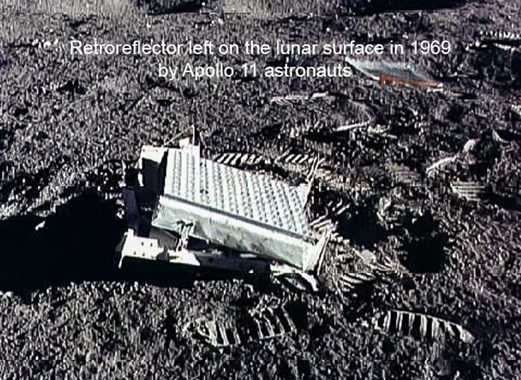
Remarkably, scientists can measure this recession with astonishing precision. During the Apollo missions, astronauts placed retroreflectors on the lunar surface — essentially mirrors designed to bounce laser beams straight back to their source. By timing how long it takes for a laser pulse to travel to the Moon and return, researchers can track the Moon's distance to within millimetres. These measurements confirm that the Moon is receding at a steady rate of 38 millimetres per year, a figure that has remained remarkably consistent.
What the Future Holds
As the Moon continues its slow retreat, Earth's rotation will keep decelerating, and our days will grow longer. Eventually, the two bodies will reach a state where no significant rotational energy is exchanged. This equilibrium, known as tidal locking, would occur in about 50 billion years, when the same side of Earth always faces the Moon. However, this timeline is purely theoretical. Long before that equilibrium is reached, the Sun will have expanded into a red giant, engulfing both Earth and the Moon.
One intriguing consequence of this recession is that in about 600 million years, total solar eclipses will no longer be possible. By then, the Moon will appear too small to completely cover the Sun, even at its closest orbital point. Only annular eclipses — where a ring of sunlight remains visible — will occur.
🌞 600 Million Years from Now: Total solar eclipses will cease to exist — the Moon will appear too small to fully cover the Sun's disk.
🔄 50 Billion Years from Now: Earth and Moon would become tidally locked — but the Sun's red giant phase will intervene long before.
📏 3.8 cm per Year: The rate of recession has remained remarkably constant for billions of years.
A Universe Never Still
In the end, the Moon's slow retreat is a quiet but powerful reminder that our universe is never static. Driven by the same gravitational forces that shape our tides, this recession has been unfolding for billions of years and will continue long into the future. While the change is too subtle to perceive in our lifetimes, its cumulative effects — lengthening our days and reshaping Earth's rotation — are undeniable. The Moon may be drifting away, but it will always remain our closest cosmic companion, its silent journey a testament to the dynamic and ever-changing nature of the world we call home.