We Are Made Of Star Stuff
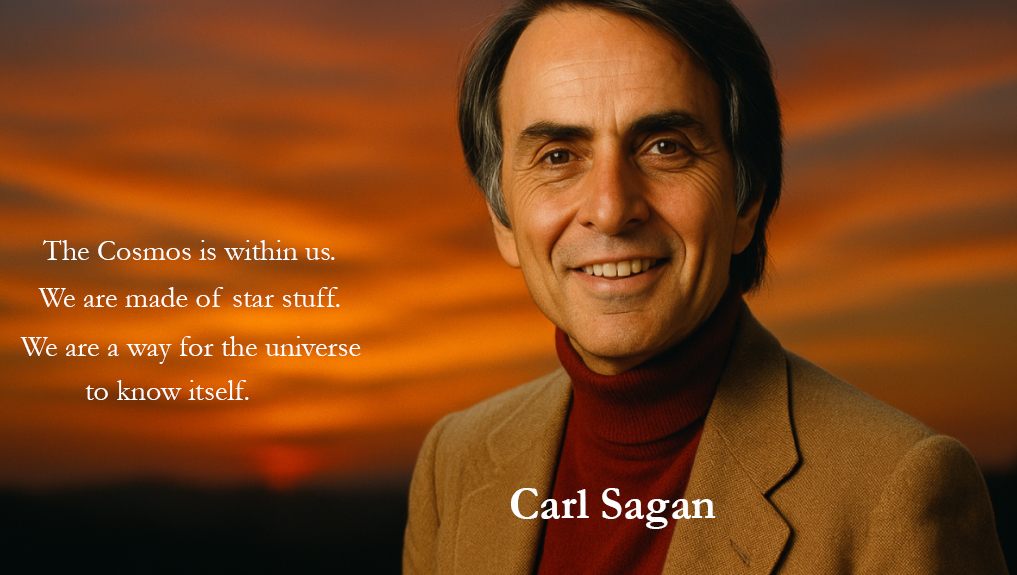
On 28 September 1980, in the first episode of his landmark television series Cosmos: A Personal Voyage, American astronomer Carl Sagan said words that have since become iconic:
“The cosmos is within us. We are made of star stuff. We are a way for the universe to know itself.”
Modern astrophysics has shown that this is not merely poetic language, but confirms this astonishing truth, the atoms that make up our bodies were forged in stars that lived and died long before the Sun was born. We are, in a literal sense, the universe becoming aware of itself.
To understand how this is possible, we must begin 13.8 billion years ago with the Big Bang. In its earliest moments, the universe was extremely tiny, hot, dense, and rapidly expanding. But it did not immediately produce atoms. For several hundred thousand years, it remained a plasma of fundamental particles. Only after about 380,000 years did the universe cool enough for electrons to combine with nuclei, forming the first stable atoms. These were almost entirely hydrogen and helium, with a small amount of lithium. No heavier elements existed yet, no carbon, oxygen, iron, or anything required for planets and life.
The first stars formed a few hundred million years later when gravity coalesced clouds of hydrogen and helium gas into dense regions that ignited nuclear fusion. In these first stars, and in the generations that followed, light elements were transformed into heavier ones. Hydrogen fused into helium, then helium into carbon. In more massive stars, fusion continued, building oxygen, neon, silicon, and ultimately iron.
Iron marks a crucial boundary in stellar physics. Fusion up to iron releases energy, but fusing iron consumes it. Once a massive star develops an iron core, it can no longer support itself against gravity. The core collapses, triggering a supernova explosion. These supernovae are among the most energetic events in the universe. They not only scatter newly formed elements into space but also create many of the elements heavier than iron—such as gold, silver, iodine, and uranium. These enriched clouds of gas and dust from dying stars eventually form new stars, planets, and, ultimately, living beings.
Our Solar System formed 4.6 billion years ago from a rotating disk of gas and dust. Much of this material was hydrogen and helium from the early universe, but the heavier elements, carbon, oxygen, nitrogen, iron, calcium came from earlier generations of stars that had already lived and died. Earth, and everything on it, is built from this recycled stellar material.
🌟 Carbon (C): The backbone of organic chemistry — forged in helium‑burning red giants.
🌬️ Oxygen (O): Essential for respiration — created in massive stars just before supernovae.
🩸 Iron (Fe): The core of haemoglobin, carrying oxygen through your veins — produced in the final stages of massive stars.
🧬 Nitrogen (N) & Phosphorus (P): Crucial for DNA and cell membranes — born in various stellar fusion cycles.
🦴 Calcium (Ca): Strengthens bones and teeth — synthesized in supernova explosions.
This means that almost every element in the human body heavier than hydrogen, carbon in our cells, oxygen in our tissues, calcium in our bones, iron in our haemoglobin, was produced in ancient stars that lived and died long before the Solar System formed. Even the nitrogen in our DNA and the phosphorus in our cells trace their origins to stellar processes. We are, quite literally, recycled star matter. Stars had to die so that we could live.
This knowledge is both profound and humbling. When you look up at the night sky at the myriad stars, you are not seeing something distant or unrelated, you are seeing the ancestral forges that made your existence possible.
Sagan’s declaration that “we are made of star stuff” is not a metaphor. It is a precise scientific fact, one of the most profound discoveries in human history. We are the descendants of stars. The universe created the ingredients for life in stellar furnaces, scattered them across space, and eventually assembled them into beings capable of understanding their own origins. "We are a way for the universe to know itself."