Sirius, the Dog Star
Sirius is the brightest star in the night sky and appears in the constellation Canis Major, Latin for “Greater Dog.” Because it is the most prominent star in that constellation, it is commonly known as the Dog Star. It shines with a brilliant white light and can sometimes appear to have a slight bluish tint when observed under steady atmospheric conditions.
The origin of the “Dog Days”
The expression “dog days” refers to the hottest period of the Northern Hemisphere summer. The phrase originates with the Romans, who called this time dies caniculares, “the days of the little dog”, in reference to Sirius. In antiquity, Sirius rose just before the Sun in late July and early August, and the ancients believed, incorrectly, that the combined heat of Sirius and the Sun produced the oppressive summer weather.
Sirius in Ancient Egypt
To the ancient Egyptians, Sirius—known as Sothis—held profound significance. Its heliacal rising (its first appearance above the eastern horizon just before sunrise) coincided with the annual flooding of the Nile, the event upon which Egyptian agriculture and survival depended. Around 3000 BCE, this rising occurred near June 25, marking the start of the Egyptian year and symbolizing renewal, fertility, and rebirth as the Nile flood deposited nutrient-rich silt across farmland.
Sirius in Ancient China
In contrast to Egypt’s reverence, ancient Chinese astronomers viewed Sirius with suspicion; it was seen as a bad omen. They called it Tiānláng (天狼), the Heavenly Wolf, an animal seen as treacherous, greedy and rapacious. To symbolically counter this, the Chinese created a constellation called Húshǐ (弧矢), Bow and Arrow. In traditional Chinese star maps, these stars form the shape of a drawn bow, with the arrow pointing directly at Sirius—a celestial security measure to protect the empire. This imagery inspired the patriotic poetic motif “shooting the Heavenly Wolf” (射天狼 Shè tiān láng), later used in literature by poets such as Qū Yuán (屈原) and Sū Shì (苏轼) as a metaphor for defending the state or repelling enemies.
Physical properties of Sirius
Sirius is a binary star system located about 8.6 light-years from Earth, about twice the distance of our nearest star Proxima Centauri. The primary star, Sirius A, is approximately twice as massive as the Sun and about 25 times as luminous. Its apparent magnitude is −1.46, making it nearly twice as bright as the next brightest star, Canopus. Its brightness is due to both intrinsic luminosity and relative proximity to Earth. For comparison, the Sun as seen from Sirius would appear as a modest star of magnitude +1.9, similar to how we see the star Deneb.
The binary nature of Sirius
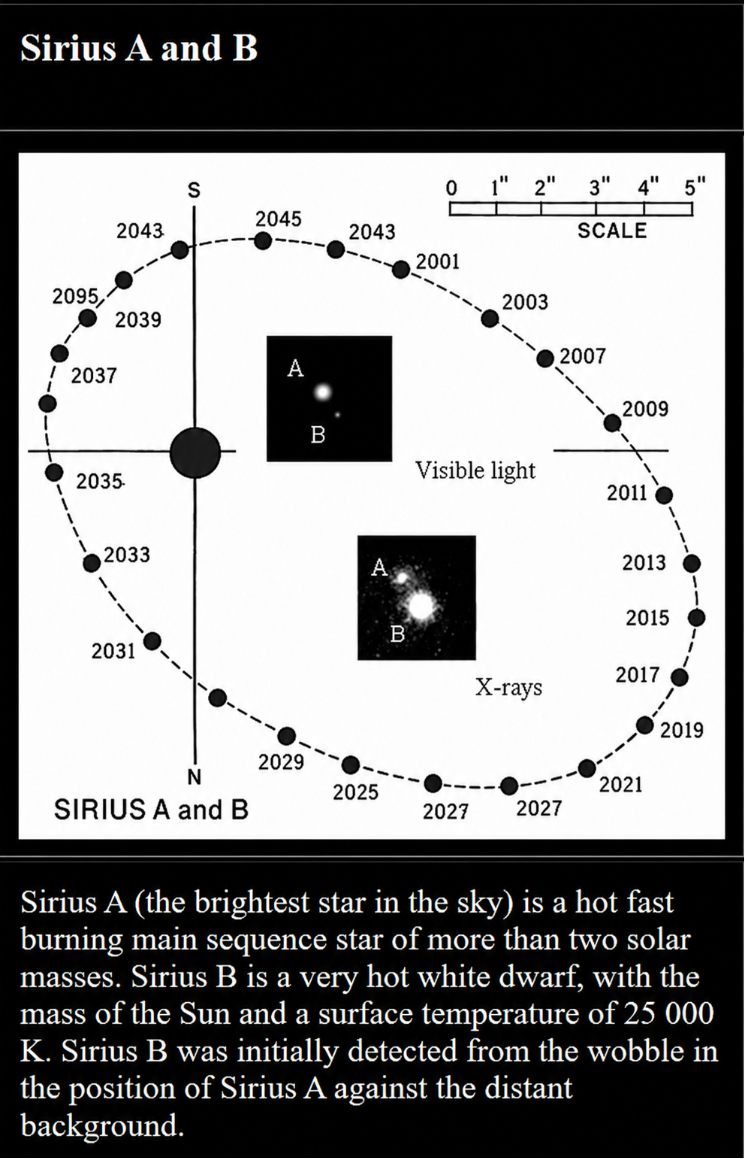
Sirius is a binary system composed of two stars orbiting one another, Sirius A and a faint companion, Sirius B. The former is a hot, luminous A‑type main‑sequence star and the latter a faint white dwarf.
The existence of Sirius B was first inferred in 1844 by German astronomer Friedrich Wilhelm Bessel, who noticed irregularities in Sirius A’s motion across the sky, suggesting an unseen companion. In 1862, American telescope maker Alvan Graham Clark directly observed Sirius B while testing a new telescope.
In 1915, Walter Sydney Adams determined that Sirius B was extremely hot but faint, identifying it as a white dwarf—the collapsed remnant of a star that has exhausted its nuclear fuel. Sirius B was the first white dwarf ever discovered, making it a landmark object in stellar astronomy.
Was Sirius Once a Red Star?
Ancient descriptions of Sirius occasionally refer to it as “red,” “ruddy,” or “fiery” in Roman and Greek literature (including writers such as Cicero, Horace, Seneca, and Ptolemy). A 6th‑century text by Gregory of Tours also refers to it with a word meaning “rust‑colored.” However, modern astrophysics shows that a star cannot change from red to white within a few thousand years—such evolution requires tens of thousands to millions of years.
Crucially, ancient Chinese astronomers consistently described Sirius as white, using it as a standard for the color white in star catalogues. Records from Sīmǎ Qiān (司马迁) around 100 BCE and later texts through the 7th century confirm this. These consistent observations strongly indicate that Sirius has not changed color in historical times.
Legacy of the Dog Star
Sirius has captivated human imagination for thousands of years, inspiring myths, calendars, omens, and scientific discovery across cultures. From Egypt’s symbol of renewal to China’s Heavenly Wolf and Rome’s “dog days,” the Dog Star reflects not only its physical brilliance but also the diverse ways people have interpreted the sky. Modern astronomy now reveals Sirius as a nearby, dynamic binary system—bright, complex, and scientifically significant—yet its long cultural legacy reminds us that even the most familiar stars can hold layers of meaning that span both history and science.
For my Chinese readers: Su Shi's poem
江城子 · 密州出猎
老夫聊发少年狂,
左牵黄,右擎苍,
锦帽貂裘,千骑卷平冈。
为报倾城随太守,
亲射虎,看孙郎。
酒酣胸胆尚开张,
鬓微霜,又何妨?
持节云中,何日遣冯唐?
会挽雕弓如满月,
西北望,射天狼。
“Then I'll bend my bow like a full moon, and aiming northwest,
I will shoot down the Wolf from the sky.”
The last two lines read: "Then I'll bend my bow like a full moon, and aiming northwest, I will shoot down the Wolf from the sky." At the time, the Song Dynasty's northern border was under constant threat from the Western Xia and Liao dynasties, both of which were located northwest of the capital Kaifeng. His poem is a bold declaration of patriotism. It was his way of expressing a fervent wish to lead troops into battle and drive out the foreign invaders. At the age of 38, a time when he had been sidelined from court due to political differences, the poem was also a subtle plea for the emperor to recall him and entrust him with a military command at the frontier.