Vulcan: The planet that never was
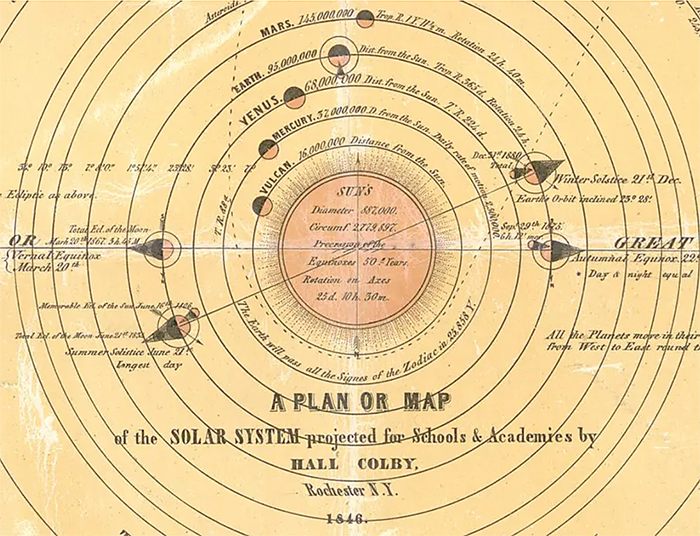
In the 1840s, the French mathematician Urbain Le Verrier used Newtonian celestial mechanics to analyse irregularities in the motion of Uranus. The planet was not following its predicted path precisely, and Le Verrier reasoned that the deviation could be explained by the gravitational influence of an unseen outer planet. Independently of John Couch Adams in England, he calculated the likely position and mass of this hypothetical body.
Le Verrier communicated his predictions to Johann Galle at the Berlin Observatory, who, together with Heinrich d'Arrest, located the predicted planet on 23 September 1846, within about one degree of Le Verrier's calculated position. The discovery of Neptune became a celebrated triumph of mathematical astronomy and reinforced confidence in Newton's theory of gravitation.
Encouraged by this success, Le Verrier turned his attention to another long-standing anomaly: the motion of Mercury. The planet's perihelion—the point in its orbit closest to the Sun—was slowly advancing over time. Most of this "precession" could be accounted for by the gravitational effects of other known planets. However, a small residual discrepancy remained, amounting to about 43 arcseconds per century.
Within the Newtonian framework, Le Verrier concluded that this leftover motion might also be caused by an unseen object. He proposed the existence of an intra-Mercurial planet, orbiting even closer to the Sun than Mercury. Such a body would be extremely difficult to observe directly due to the Sun's glare. He named the hypothetical planet Vulcan, after the Roman god of fire.
The idea quickly attracted interest. In 1859, the French physician and amateur astronomer Edmond Modeste Lescarbault reported observing a small dark object crossing the face of the Sun, which Le Verrier accepted as possible confirmation. Other alleged sightings followed, particularly during solar eclipses, when observers reported transient dark shapes near the Sun. At the time, no consistent or reproducible evidence emerged, and many astronomers remained sceptical, but the idea of Vulcan persisted in some circles for decades. Le Verrier himself continued to defend the hypothesis until his death in 1877.
Despite extensive searches, no intra-Mercurial planet was ever reliably detected. The puzzle remained unresolved until the early 20th century, when Albert Einstein introduced the general theory of relativity in 1915. In this new framework, gravity is not a force transmitted through space but a consequence of the curvature of spacetime caused by mass and energy.
When Mercury's orbit was recalculated using general relativity, the previously unexplained precession was accounted for precisely—without requiring any additional planet. The curvature of spacetime near the Sun naturally produces the observed effect. As a result, the need for Vulcan disappeared, and the hypothesis was ultimately abandoned.
The story of Vulcan became an instructive episode in the history of science. It demonstrated how a logically sound inference, based on the best available theory, can still be misleading if the underlying framework is incomplete. Newtonian mechanics was extraordinarily successful, but not universally sufficient under all conditions.
A Lesson for Modern Planet Hunters
This historical episode is often mentioned in discussions of modern astronomical searches for hypothetical distant objects, such as the proposed "Planet Nine." While some anomalies in the outer Solar System have been interpreted as possible indirect evidence for such a body, the Vulcan episode serves as a reminder that apparent gravitational discrepancies do not always imply an unseen planet. Careful observation and multiple lines of evidence are essential before revising the architecture of the Solar System.
Interesting Facts About the Hunt for Vulcan
🧮 43 Arcseconds of Mystery: The unexplained part of Mercury’s perihelion precession was tiny — only 0.000012 degrees per century — but it drove astronomers to invent an entire planet.
👨⚕️ A Doctor’s Discovery: The most famous claimed sighting of Vulcan came from Edmond Modeste Lescarbault, a French country doctor and amateur astronomer who used a simple telescope and a stopwatch.
🌑 Solar Eclipse Searches: Dozens of professional astronomers scanned the Sun during eclipses in the 1860s–1880s, reporting occasional “intra-Mercurial” dots — but never the same one twice.
📜 Le Verrier’s Obsession: Urbain Le Verrier became so convinced Vulcan existed that he reportedly dismissed contradictory evidence and even named Lescarbault’s alleged object “Vulcan” on the spot.
🕰️ How Einstein Solved It: In 1915, Einstein’s general relativity calculation perfectly matched the 43 arcseconds — a triumph that helped make him world-famous.
The phantom planet Vulcan never existed, but its legacy endures as a cautionary tale. It reminds us that science progresses not only by confirming predictions but also by gracefully retiring beautiful hypotheses when they no longer fit a deeper understanding of reality. And for Star Trek fans, the name lives on as one of the most beloved fictional worlds in science fiction.