Tycho Brahe's nose
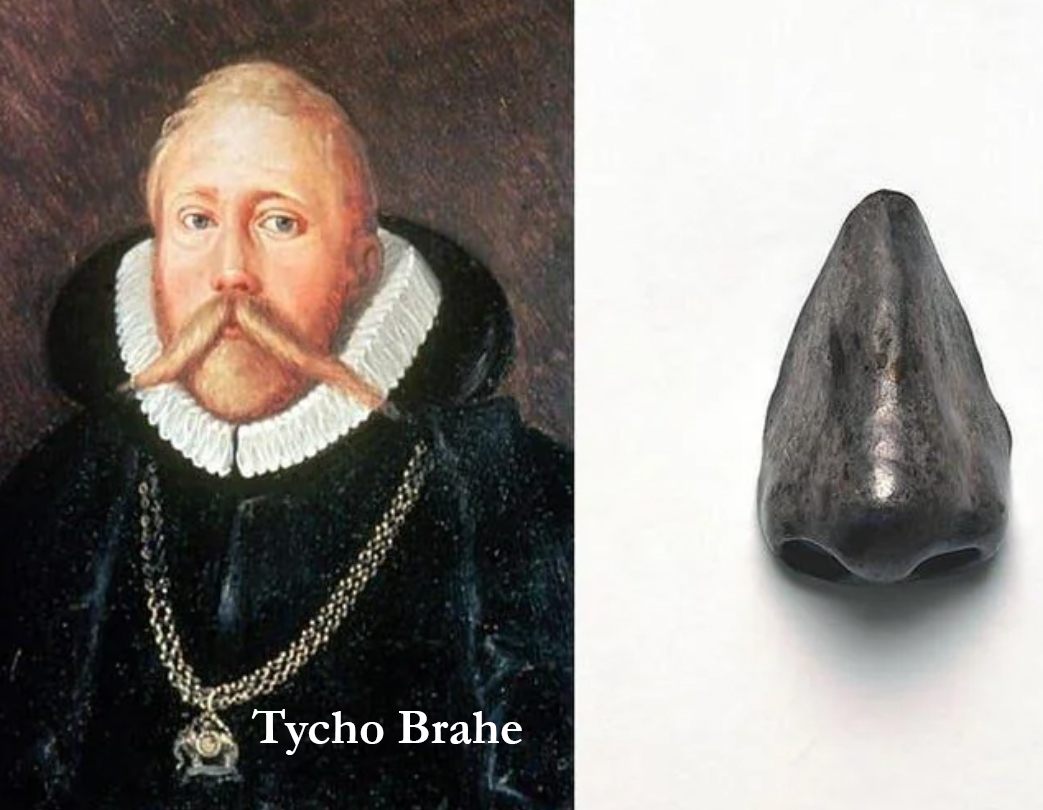
In the 16th century, there was a profound change in the idea that the Earth was the center of the universe. The concept that our world was one of several planets in an elliptical orbit around the sun in a vast space populated by distant stars begin to take shape. Among the many astronomers who galvanised this idea is Tycho Brahe, a big red-bearded Danish nobleman, astronomer, astrologer and alchemist.
Three remarkable observations
He provided three remarkable observations. His study of the supernova in 1572 refuted the celestial spheres are unchanging and immutable. He deduced that the great comet of 1577 was much further than the moon, confirming his prior anti-Aristotelian conclusions about the fixed nature of the sky beyond the Moon. Finally, his accurate positional recordings of heavenly bodies before the invention of the telescope provided material from which Kepler was able to deduce the laws of planetary motion.
The duel that changed his face
Tycho Brahe though brilliant was fiercely proud and hot-tempered. His temper and pride would cost him the bridge of his nose. On 29 December 1566, aged 20, as a student at the University of Rostock, he had an altercation with his third cousin Manderup Parsburg, another Danish nobleman. Previously on 10 December the two had drunkenly argued over who was the superior mathematician. On 29 December, they decided to resolve their feud with a duel in the dark. In the duel Parsberg sliced off the bridge of Brahe's nose. He did however made up with his cousin a few weeks later.
How bad was the injury?
The details of his injuries are far from clear. A couple of academic papers infer to "most of his nose" but this is not in keeping with many contemporary depictions of Brahe. They generally show him wearing a prosthesis covering only the bridge of his nose with little apparent damage to the alae and apex.
Examination after the second exhumation in 2010 revealed nasal bones mainly intact but with perhaps slight defect on the left hand side. It can reasonably be concluded that nasal injuries sustained by Brahe were to the lateral cartilages.
A nasal prosthesis for a fashion-conscious nobleman
Regardless of the extent of the wound, the fashion conscious Brahe chose to wear a nasal prosthesis. In the 16th century, nasal prostheses were not exactly rare. The number of people with collapsed nasal bridges as a result of tertiary-stage syphilis was on the rise and nasal protheses were a perfectly normal cosmetic necessity.
For centuries the composition of his prosthetic nose was subjected to speculation. The conventional believe is that the fashion conscious Brahe had two prostheses made, one of gold and silver for festive occasions and another of brass for everyday wear. The exhumations of Brahe in 1901 and 2010 showed high levels of zinc and copper in the nasal cavities of the skull. This would suggest that brass prosthesis was frequently worn rather than gold or silver.
Aristocrat or astronomer?
Brahe prefer to think of himself as an aristocrat rather than an astronomer. He always wore court costume while performing his astronomical observations. Astronomers and mathematicians in the 16th century were usually branded with low social status. The most obvious explanation why he chose to wear court costume is that he wanted to dissociate himself with such low status.
Legacy
Tycho Brahe revolutionised astronomy through his remarkably precise observations, challenging ancient ideas about the heavens and paving the way for modern science. His work provided the foundation for Johannes Kepler to discover the laws of planetary motion, making Tycho a key figure in the birth of modern astronomy.