Sweden's First Satellite: The Hasselblad That Escaped Into Orbit
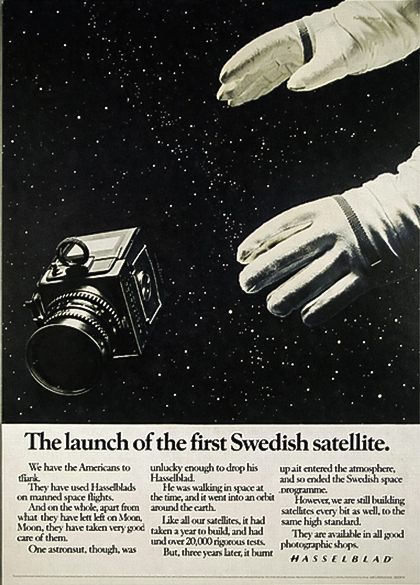
When we think of the historic Apollo 11 mission, the names that immediately come to mind are Neil Armstrong and Buzz Aldrin. Far fewer people remember the third member of the crew, Michael Collins, the command module pilot who remained alone in lunar orbit while his colleagues made their immortal descent to the surface. Fewer still know that Collins also became, quite unintentionally, the first person to launch a Swedish “satellite” into orbit.
The Gemini 10 Mishap
The incident occurred on July 18, 1966, during the Gemini 10 mission. At just 31 years of age, Michael Collins had already established himself as one of NASA's most skilled astronauts and spacewalkers. During the mission he was assigned a demanding series of tasks: leaving the Gemini capsule, manoeuvring in open space, retrieving a micrometeorite collector from an Agena target vehicle, and carefully documenting the operation with a specially modified Hasselblad camera attached to his spacesuit.
The camera was a 70mm Hasselblad SWC (Super Wide Camera), specially adapted for use in space. During the spacewalk, after Gemini 10 had successfully docked with its Agena target vehicle, Collins ventured outside to retrieve scientific experiments while simultaneously managing his safety tether to avoid becoming tangled in the spacecraft. Amid the complexity of working in zero gravity, the Hasselblad somehow came loose from his suit and silently drifted away into space.
In his memoir, Carrying the Fire, Collins explained that he had simply been overwhelmed by the number of tasks he was performing at once — controlling his movements, managing the tether, collecting experiments, and handling equipment. At some point, the camera floated away unnoticed. What disappointed him most was not the loss of the camera itself, but the fact that no photographs survived from one of the earliest and most significant spacewalks ever attempted.
Hasselblad's Humorous Take: “The First Swedish Satellite”
Hasselblad, however, saw the humour in the mishap. In 1978 the Swedish camera company published a now-famous advertisement titled "The Launch of the First Swedish Satellite". The illustration showed a drifting Hasselblad camera floating just beyond the reach of an astronaut's gloved hand. According to reports, the company's founder, Victor Hasselblad, was delighted by the publicity, joking, “We couldn’t buy that kind of coverage.”
📷 The Accidental Pioneer: While Sweden's first official satellite, Viking, launched in 1986, the Hasselblad camera beat it by two decades — becoming an unofficial, accidental Swedish orbiter.
🕹️ Genius Marketing: The 1978 advertisement turned a NASA blunder into one of the most beloved stories in space photography history.
🎖️ Michael Collins: Despite the mishap, Collins remained one of NASA's finest astronauts — and later flew on Apollo 11, where he almost lost another Hasselblad.
Almost Lost Again on Apollo 11
Collins nearly repeated the feat three years later aboard Apollo 11. While preparing to photograph the lunar module Eagle as it departed from the command module Columbia, he suddenly realised that another Hasselblad camera was missing. A frantic search of the cramped spacecraft followed before Collins finally discovered the camera wedged in a footwell. Thanks to that recovery, he was able to capture some of the most iconic photographs of the mission, including images of Eagle ascending from the lunar surface with Earth hanging in the blackness of space beyond.
The Satellite's Fiery End
As for the lost Gemini 10 camera, its fate was almost certainly sealed long ago. Because it was left in relatively low Earth orbit, atmospheric drag would gradually have slowed it down and caused its orbit to decay. Within months, or perhaps a few years, the wandering Hasselblad would have re-entered Earth's atmosphere and burned up in the intense heat of re-entry, ending the brief life of history's accidental first Swedish satellite.
In the end, the story is a small reminder that even carefully planned space missions still had room for mishaps and surprises. The simple loss of a camera has become a curious footnote in the history of spaceflight, adding a human touch to an era defined by extraordinary technical achievement. Michael Collins may have been the loneliest man in the universe during Apollo 11, but in 1966 he was also the unwitting launcher of Sweden's most charming piece of space junk — a camera that saw the stars, briefly became one, and then returned to Earth in a blaze of glory.